
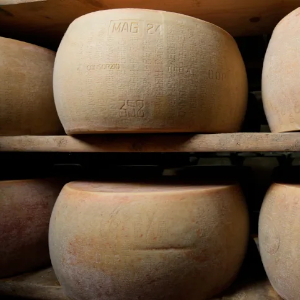
A new bank is making operating capital available to Italy’s cheese makers, accepting young cheese as collateral on loans. Rising costs and slowing sales have producers on edge. But Italy’s Parmigiano industry is breathing a sigh of financial relief…
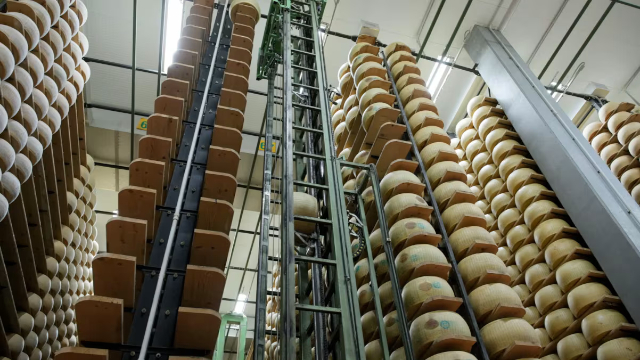 Described by one food writer as ‘a cathedral of cheese’, the racks at Italy’s
cheese bank hold 500,000 wheels of closely guarded Parmigiano…
How it works…
The Credem Bank was set up to fill a financial gap in the Parmigiano production process. The cheese must age at least a full year, under precisely controlled conditions, to legally be sold as real Parmi-giano Reggiano. That’s just one stipulation under which the coveted stuff is made, to conform to Italy’s ultra-tight rules and regulations.
“That long wait creates a financial bottleneck,” Antonia Mortensen and Juan Pablo O’Connell re-port. “Farmers must be paid every 30 days. Staff, feed and energy costs accumulate daily. But [the] revenue doesn’t arrive for a year or more. For more than a century, Credem Bank has stepped in to bridge that gap — accepting cheese as collateral”
A remarkable story
Some exceptional Parmigianos are aged for 24, 36 or even 40 months. The Credem Bank has bridging loan plans to fit them all.
Of course, cheese is always coming and going at the bank. Giancarlo Ravanetti, the warehouse’s boss, explains, “In Italy about 4 million wheels of Parmigiano Reggiano are made [each year].” The ware-house handles, “about 2,300,000 wheels a year.”
The value of the product under Ravanetti’s care is nothing short of monumental: “About 325 million euros ($382 million) worth of Parmigiano Reggiano.”
More than just storage
The Credem bank provides more than just storage. It’s part of the deal includes keeping the cheese at just the right temperature and humidity to age properly, and periodically inspecting the wheels for any cracks or other issues that would affect quality.
At the 12-month point, the bank’s technic-ians per-form what’s called the ‘tapping test’. Each wheel is struck with a mallet and highly trained cheese evaluators listen for any sounds that might indicate any internal defect. Only then does a wheel receive the traditional fire-branded ‘geniune Parmigiano’ seal.
Even more important
Paolo Ganzerli represents Granterre, one of Italy’s largest dairy groups. It’s essentially a regular stock-issuing company, but most of the stock is owned by milk and cheese producer cooperatives. From his lofty perch, he sees the arrangement as both a strength and a vulnerability at the same time.
The continuing high cost of everything – including cattle feed, transportation and energy – has hit the milk and cheese industries hard. It’s even more important, now, that institutions such as the Credem Bank remain strong.
“Without this system of leverage, the world of Parmigiano Reggiano cannot exist,” Ganzerli insists.
My take
I wondered how stable the Credem is, relying on farmers, who in turn rely on the weather and the health of their cows, to repay their loans. The bank can only keep up its end of the bargain as long as the borrowers keep up their end.
Ravanetti gives reassurance – for all in the Parmigiano loop: The bank and the system it supports have operated for more than a century, and the bank has never lost a single euro on its loans.
~ Maggie J.