
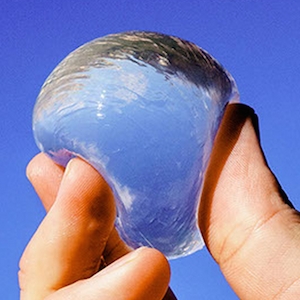
The plastic your bottled water comes in is certified ‘food-safe’. But new research reveals bottled water is riddled with microplastics. Where’s it coming from? What’s a conscientious bottled water drinker to do?
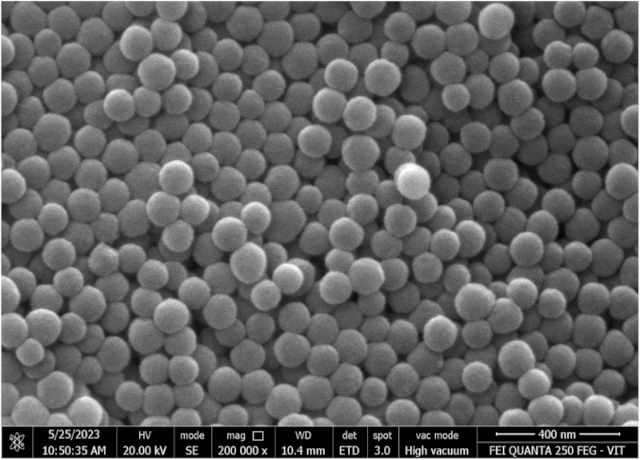 Nanoplastic particles under the electron microscope…
You followed the official dietary guidelines and made water your ‘beverage of choice’. And you thought you’d be healthier for it. The internet influencers told you plain old tap water isn’t safe, either. Enter, the rock and the hard place…
A little history…
We’ve been hearing for years, now, that you can’t – or at least, shouldn’t – drink the tap water in certain places around the globe. In fact, many American cities have become notorious for less-than-wholesome municipal water. The standard solution to the problem used to be, drink only bottled water. It’s specially filtered and treated to be safe.
But now scientists warn that bottled water is probably no safer than the water in your taps. And it’s not because of bacteria or chemical contaminants. The issue is microplastics.
They’re literally everywhere…
Micro- and nanoplatics (MNPs) are everywhere these days.
“Humans are constantly exposed to MNPs in their daily lives because they are encountered virtually everywhere, from packaged food and beverages, to produce and drinking water. MNPs are even in the air that we breathe,” the preamble to the new study cautions.
And the researchers also note that there has been considerable research on tap water MNP contam-ination, there has been very little prior research on bottled water contamination. One majpr advance in their testing method over previous ‘standard’ measurements was the employment of new tech-niques able to detect and measure plastic particles an order of magnitude smaller than those detected by other techniques.
What they did
If the technology behind their experimental plan was complex, the premise was deceptively simple:
“We conducted a direct comparison of MNP concentrations in treated drinking water produced by conventional water treatment plants and bottled water.”
What they found
The particle concentrations in the bottled water samples were significantly higher than those in the treated drinking water samples. That was a bit of a surprise, initially, until the researchers noted that the higher concentrations were accounted for largely by nanoparticles (NPs). Contaminants on that tiny scale had not been measured in previous experiments.
The takeaway
“The results suggest that previous studies have underestimated the MNP particle concentrations in both treated tap and bottled water,” their conclusion states. “This was attributed to the inclusion of NPs in this study as they accounted for over 50% of the detected particles in both sample types.”
“We can make educated choices to try and reduce our daily exposure to these harmful chemicals,” Megan Jamison Hart, lead author and a PhD candidate in environmental sciences at The Ohio State University, said. “For the average person who is thirsty and wants a drink, the best way to do that would be drinking it straight out of the tap rather than grabbing pre-bottled water.”
My take
“We don’t really fully understand the human health risks associated with nanoplastic exposure,” Hart explained, in a news release. “It’s still better to try and mitigate that risk because evidence indicates that they do cause problems, even if we’re not fully aware of what those are yet.”
Seems a reasonable position to take. And I agree with her. I’m just anxious to see that those as-yet-unknown problems turn out to be…
~ Maggie J.