
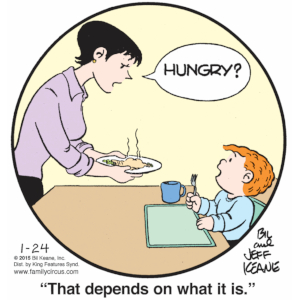
Have you ever had a kid say, “Yuk!” to lunch because of some seemingly small, perceived flaw? Researchers recently decided to apply the scientific method to determine what the key tyke food turnoffs are. And even they were surprised…
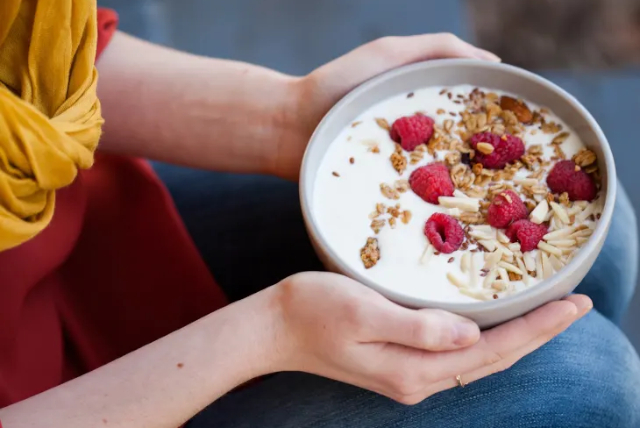 Yogurt with Berries, Nuts and Coconut: Great nutrition, unappreciated by 6-year-olds…
There’s nothing more frustrating for a parent or childcare giver than dealing with a kid who – for some reason or another – refuses to eat. And it’s not always easy to figure out what it is that’s turning the kid off their lovingly prepared lunch…
What they did
A team from the University of Copenhagen (UoC) set up a simple experiment involving 485 children between the ages of five and twelve.
They asked the kids to look at a series of drawings of different foods. The foods were common, every-day items the kids were familiar with: bread, orange juice, peanut butter, strawberry jam, yogurt and tomato soup.
But there were two versions of each food. One displayed each in its natural glory, with all the pits, lumps and grainy textures. The other depicted ‘smooth’ versions of each food.
What they found
As you might expect, the kids showed an overall preference for foods, “without lumps, seeds [or] pieces of fruit in them.” But the researchers were surprised to learn there there was a definite spike in lump rejection around age 6. In fact, a substantial 76 percent of 6-year-olds expressed a preference for food without lumps.
“The fact that children in general are not happy with […] lumps in food is probably something many people can recognize,” says Dr. Ching Yue Chow, first author of the study. “But this is the first time that a scientific study has linked a specific age group, namely six-year-olds, so clearly to this food preference.”
That discovery was enough of a surprise to spur a succeeding set of experiments in which real foods were offered to kids, rather than just showing them drawings. The results remained the same.
The takeaway
Whatever the cause of the spike in lump rejection, its abrupt onset at age 5 or 6 was followed by an equally abrupt decline in lump awareness at age 7 or shortly thereafter. So the researchers pass on comforting news. It appears kids will be all the more willing to try new foods after age 6.
“As children reach school age, they may become more influenced by classmates and others within their circle to try new types of food and have more of a desire to expand their horizons. We can also see that the proportion that would like to have food with chunks in food grows in concert with their age in the study,” Ching observes.
My take
It all comes down – in my humble opinion – to what folks used to call kids’ ‘going through a phase’. My maternal grandmother more than once counselled my Mom, “This, too, shall pass!”
But she also, often, quoted the eternal verity: “Patience is a virtue, which cannot be denied…”
~ Maggie J.