
Is the motivation desperation? Snack makers have hit a wall – of consumer rebellion, over both sky-high prices, and nutritional issues. Manufacturers like Lay’s are jumping on the protein bandwagon to make their products ‘healthier’ and more ‘functional’…
Embracing protein actually meets two challenges for snack brands… First, it lets them claim their products are healthier, ‘infused’ and ‘fortified’ with good stuff. At the same time, it gets them in on the surging protein craze which is taking the Western World by storm…
Everybody’s doing it…
Adding protein, that is. And in many cases, the addition is superfluous. In others, it’s downright clashy. In that respect, I have always specifically questioned the rationale behind protein-infused drinks. But that’s for another day…
The focus today is salty, fatty snacks. And their recent plunge into the protein bubble, manufacturers such a Lay’s (a PepsiCo company) have exposed themselves to criticism on a number of fronts.
Health issues
First… Voices in the medical and nutrition communities have been asking: “Shouldn’t snack makers be taking ‘bad stuff’ out of their products, rather than trying to make them more attractive by suf-fusing them with ‘good stuff’?”
Good point. Some effort has been made, since the Millennium, to reduce the harm UPF foods such as salty, fatty snacks can wreak on folks – specifically on growing children. Snack makers started by cut-ting the amount of salt they add, and changing the oils and fats they fry their creations in. But that was about as far on that road as they could go.
Economic pressures
At the same time, rising food costs – including basic ingredients for the snack industry such as corn, wheat and potatoes – have forced snack prices up accordingly. Other costs, including packaging, transportation and marketing (which has intensified), have also increased.
The bottom line? A family-sized bag of chips that only a year ago cost around $5 now costs $7 or $8. And fans are literally not buying it.
What’s a snack maker to do?
Facing a seemingly unbreachable, unscalable wall, Lays recently decided the solution was to try to go around it. So they added protein to their existing products and ride the wake of that fad/phenomen-on and try to divert consumers’ attention from the problems that are too tough to solve (at least at the moment).
In what the snack makers no doubt hope will constitute a nice, neat, full-circle consummation, the addition of protein to their products might even make them seem ‘healthier’ to fans…
The protein conundrum…
Alas, the medical and nutrition communities disagree with the snack makers about protein.
The Mayo Clinic advises: “Contrary to all the hype that everyone needs more protein, most people in the U.S. meet or exceed their needs. This is especially true for males ages 19-59. The Dietary Guide-lines for Americans, 2020–2025 indicates that men in that age range exceed their protein recom-mendations, especially from meat, poultry and eggs.”
Mayo further specifies that Protein should account for 10 percent to 35 percent of your calories. If your daily needs are 2,000 calories, that’s 200-700 calories from protein or 50-175 grams.
Compare the new Doritos…
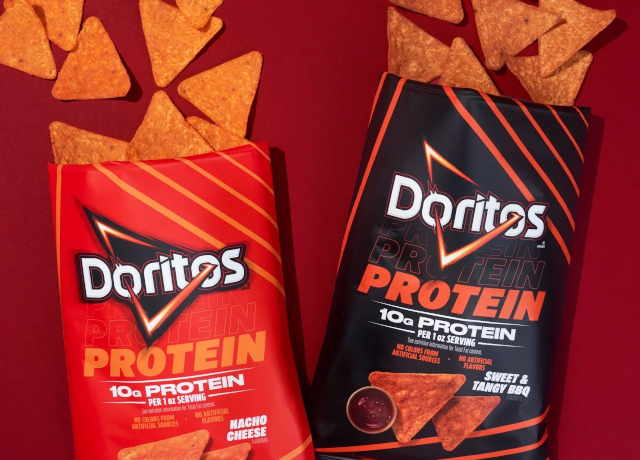
The official PepsiCo/Lay’s news release boasts that each 1 oz / 28.4 g serving of their new Doritos Protein delivers 10 g of protein. A whole large-size (7 oz) bag contains 70 g of protein. And the 12.75 oz ‘party’ pack embodies 127.5 g!
Now, add that to the protein you’re already getting in your regular diet…
‘Get your protein from ‘real’ foods’
Canada’s Food Guide sums up the official position of virtually all Western World authorities, that a little protein goes a long way. And we should be getting it from natural, whole foods.
“You don’t need to eat large amounts of protein foods to meet your nutritional needs. Try to eat protein foods such as:
- eggs
- lean meats and poultry
- nuts and seeds
- fish and shellfish
- lower fat dairy products
- beans, peas and lentils
- soy beverages, tofu, soybeans and other soy products”
“Try to choose protein foods that come from plants every day. Plant-based protein foods can provide more fibre and less saturated fat than other types of protein foods. This can be beneficial for your heart health.”
My take
It’s hard to come out and say that protein-fortified snacks are a waste of money, a pointless excess of protein, or simply a justification for sustained high prices.
But it’s clear that added protein is an un-necessary ‘frill’ in salty, fatty snacks. And offers no added health benefit over and above the higher-quality proteins we get in our regular, daily diets.
~ Maggie J.