

We tend to think of dreaded diseases such as Colon Cancer (CC) as being ‘older person issues’. But new science has discovered that colon cancer cases in younger adults are surging worldwide, driven by lifestyle choices and inherited genetic risks…
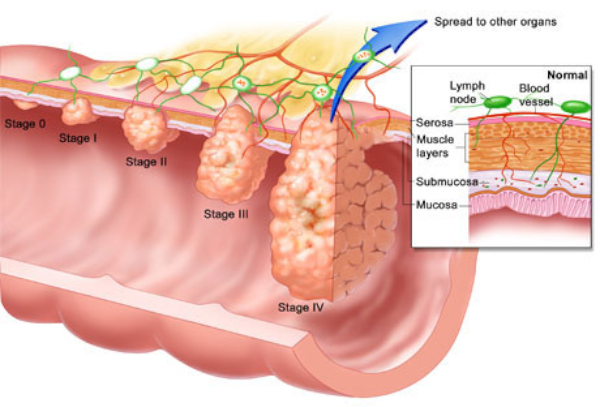 Colon Cancer Stages: Aggressive and invasive. With a high mortality rate…
When my family physician first brought up the subject of colon cancer and regular colon exams, I had just left my 50th birthday in the dust. “No need to start doing this earlier,” she smiled an evil smile. “Younger folks don’t get colon cancer.”
Fast-forward to today…
A large international 20-teens study published in The Lancet Oncology found a clear increase in CC diagnoses among younger adults. From 2013 to 2017, incidence rates rose in 27 of the 50 countries included in the analysis for people under the age of 50. Although the highest numbers continue to appear in North America and Europe, notable increases were also reported across Eastern Europe, South-Central and Southeastern Asia, and South America.
What they’re doing
Now, science says anybody can get the life-ravaging disease at any age. And younger people are now recognised as being at increasing risk. Researchers believe this global pattern reflects broad changes in daily life, including shifts in diet, reduced physical activity, urban living, and various environmental exposures.
Researchers at BGI Genomics are examining the forces pushing the rise in early-onset CC. And ad-vances in genetic testing are opening new possibilities for CC prevention and earlier detection.
What they’ve found
Research increasingly points to diet as a major contributor to colorectal cancer risk. High intake of ultra-processed foods, red and processed meats, and sugary drinks has been associated with inflam-mation and a greater susceptibility to cancer.
Hand in hand with diet, obesity poses a similar colon cancer risk. is another important factor tied to CC. Excess body fat can drive chronic inflammation and interfere with normal metabolic processes.
Genetics also plays a significant role in early-onset CC. According to Dr. Alexei Tsukanov, head of the Laboratory of Genetics at the National Medical Research Center for Radiology, many younger CRC cases are linked to inherited cancer syndromes such as Lynch syndrome and familial adenomatous polyposis. These disorders are caused by mutations in tumor-suppressor genes, which sharply in-crease the likelihood of developing CC at a younger age.
The takeaway
Colorectal cancer is no longer confined to older populations. Younger adults are increasingly af-fected, with unhealthy lifestyle patterns playing a major role. Addressing this growing challenge will require coordinated action from governments, healthcare systems, and individuals to raise aware-ness, support healthier choices, and expand access to early screening. The urgency of the situation continues to grow.
Specialists emphasize that earlier screening, healthier eating habits, and stronger public education are essential to slow this trend. Without effective intervention, experts warn that early-onset CRC cases are likely to continue rising over the coming decades.
My take
“The annual cost for colon cancer treatment varies significantly but averages around $50,000 to over $60,000 in the first year.,” Google search reports. “Ongoing care costs decreasing but still substantial, driven mainly by chemotherapy and hospitalizations, and can range from tens of thousands to over $100,000 annually depending on stage, treatment regimen, and location.”
In addition: “About 1 in 24 men and 1 in 26 women worldwide [will be diagnosed with CC] in their lifetime. […] In the U.S., around 154,000 new cases were expected in 2025, while in Canada, about 26,000 new diagnoses occur yearly, with rates higher in men than women.”
At an average $75,000 per year to treat each CC sufferer, that works out to over $11.5 billion total, to take care of those 154,000 new cases per year. Any new science that emerges from current and ongo-ing research can’t come soon enough. And we, as potential sufferers, need to take note and make the necessary lifestyle changes necessary to reduce our risk of CC…
~ Maggie J.