
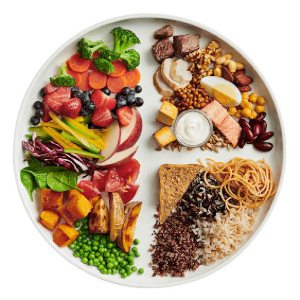
I’ve often wondered how much influence the major agriculture industry powers exert on Canada’s official nutrition guidelines. Ideally, they should have none at all. Canada’s Food Guide should reflect solid science and common sense…

They sure tried!
A study by two University of Montréal (UM) academincs reveals that major food industry lobby groups made a major effort to influence the 2019 review of Canada’s Food Guide.
A massive effort
The egg lobby doesn’t want the official nutrition Guide to say, “Eat fewer eggs!” Nor does the beef lobby want the Guide to say, “Eat less red meat!” So, it makes perfect sense that the agri-food sector would want to influence the recommendations in Canada’s Food Guide.
“During the three-year review process, major Canadian agri-food players used a range of strategies to oppose the changes. In all, they conducted 366 corporate political activities (i.e. lobbying efforts) of which 82 (22 percent) involved criticizing the scientific data on which Health Canada based its recommendations and 76 (21 percent) involved submitting non-peer-reviewed, cherry-picked industry-friendly data,” writes UM research reviewer Martin Lasalle at PsyOrg.com.
The study, published in the December 2023 issue of Health Promotion and Chronic Disease Prevention in Canada, revealed that food industry players submitted 11 separate briefs to the House Standing Committee on Health during its public consultations on revisions to the Guide. This sizeable effort, in spite of the fact that industry players were officially excluded from the consultations.
Four main strategies
The study’s lead author Marie-Chantal Robitaille found that food lobbyists used 4 main strategies to try to pressure the Committee:
- Information management: e.g., suppressing information, using the credibility of a third party
- Discursive strategies: e.g., framing the debate on food and public health-related issues to favor industry interests
- Political influence: e.g. direct lobbying and indirect access to policy makers
- Coalition management: e.g., establishing a network of support, especially with health professionals and other opponents
Egregious examples
Robataille cited 98 examples of industry reps criticising the scientific evidence, emphasizing its complexity and admitted margins of uncertainty.
She also noted that The Egg Producers of Canada, offered a brief which argued that, “consultation and dialogue with […] food producers […] is an important step to ensure a balance of opinions are heard throughout the process.” This in spite of the fact that industry participation in the review process is prohibited, for obvious reasons.
“This decision by Health Canada was supported by the scientific literature and the World Health Organization, which has found that public-private collaboration can undermine the focus on the public interest and make it more difficult to establish public health policies,” Robitaille remarked.
But in the end, Robataille concluded that the attempts by the food industry to influence the Food Guide review had zero effect.
My take
The food industry collective wields huge and powerful force. But it came up against a wall when it tried to influence the content of Canada’s Food Guide – the official national nutrition resource. And so it should be!
I was at first surprised that anyone – let alone a university researchers would assay an analysis of the issue. But that was before I discovered how hard private interests tried to garner favours for their products among the official nutrition recommendations.
It makes sense that food industry lobby groups would want to fight for their vested interests. But it makes perfect sense that they should be excluded from the review process.
~ Maggie J.