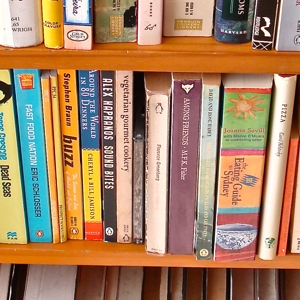
People keep asking me which version is right: Is it ‘cookbook’, ‘cook book’, or something else alto-gether? I’ve seen both used in what I considered authoritative publications. But it took some digging to get to the real, honest, true answer to that question…
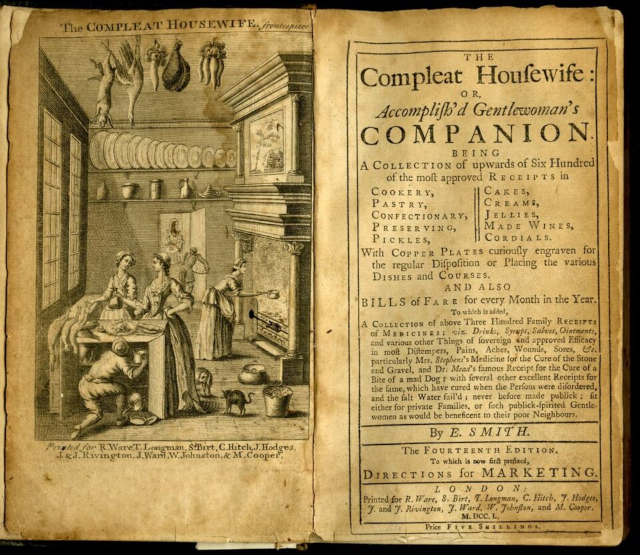 One of the first English-language ‘comprehensive guides’ to cooking – 1749…
I’ve been using ‘cookbook’ all my life to describe those tomes that generally offer recipe compila-tions and often annotate them with cooking techniques and tips. But folks have, for the past few years, been asking me if ‘cook book’ isn’t the ‘correct’ way to spell it.
I’ve come to the conclusion that I have taken the word(s) so much for granted that I never really take note of which version I’m reading!
It’s not the same as some folks spelling ‘bleach’ as ‘Clorox’, and others spelling it ‘Javex’. It’s the same word when you say it, no matter how it’s spelled.
Unknown territory
SO… I feared I’d be braving unknown etymological territory when I geared-up for my exploration into the roots of ‘cookbook’. But it turned out that there are many, many opinions on the issue scattered all across the Internet.
My first notion was to check with all-knowing Wikipedia, to see that it had to say on the subject. And I was not disappointed. Just more confused than when I started. TMI.
Then, I decided to see what Google AI would say if I asked it the ‘question of the day’. The souless servant replied:
“AI Overview:
- Cookbook (One word): is the modern, preferred, and most common spelling for a book of recipes and cooking instructions. ‘Cookbook’ is universally recognized as a comprehensive guide to cooking.
Key Differences and Usage:
- Cookbook (Preferred): A comprehensive book containing recipes and cooking instructions.
- Cook book (Dated): The two-word variation, largely obsolete in modern publishing.
- Cookery Book (Regional): Common term in British English, equivalent to ‘cookbook’.
- Cooking Book: Sometimes used to refer to a manual focused more on techniques, theory, or educational content, rather than just a collection of recipes.”
But there’s more…
What if we rate the above versions according to when they came into usage? We find that ‘Cookery Book’ was the first usage to appear in print. And such tomes were among the first books to reach wider audiences thanks to the printing press… And it appears that ‘Cookery Book’ was commonly used in England right up to the dawn of the 20th Century.
‘Cook Book’ came into wide use only in the mid 20th Century. All indications point to a blossoming of the single-word form during the post WW II ‘boom’: when the ‘boys’ came home, when many women returned to the home (and kitchen) after having done the men’s work during the War, and when family life finally slowly returned to what folks traditionally thought of as normal.
My take
I feel bound to nominate at least one more possible option, which has been waiting in the wings to see where it might fit into the greater scheme of ‘cookbook’ things.
If we’re going as far as Google did, why not admit ‘Recipe Book’ to the pantheon? “Wait!” I hear the purists say: “It’s not a ‘comprehensive guide to cooking’!” True, it only contains recipes – officially. But it could contain tips and techniques. I have several ‘Recipe’ books in my collection that do just that…
Nevertheless…
The available information tends to suggest an orderly evolution of the term ‘Cook Book’ from its earliest roots.
Henceforth, I propose to use ‘Cookbook’ in all applications and circumstances the term may encounter in this space.
I have spoken.
~ Maggie J.