
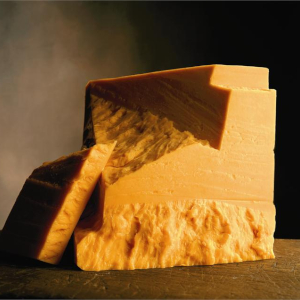
A brain light bulb flashed on when I read a recent Buzzfeed listicle about ‘Things Every Single Amer-ican Believes Are Completely Normal But Are Actually Very Strange’. One list entry focused on the differences in scale between the US and EU – and cheese…
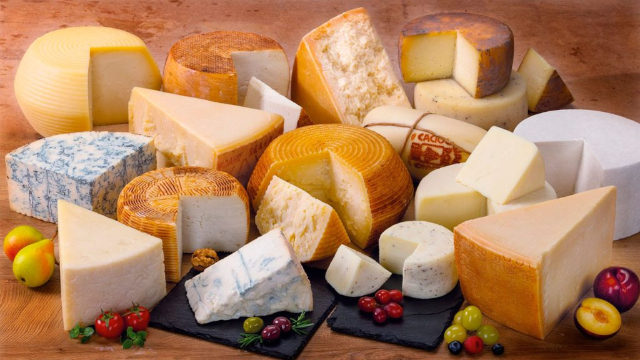 An array of just a few European cheeses, whose authenticity
is guarded by Protected Domain of Origin (PDO) laws.
The trigger…
It was list item number 47 that got me thinking…
One European visitor to the US remarked, “[Y]ou can drive for five hours in the United States and still be in the same place more or less. If you drive for five hours in Europe, suddenly everyone’s talking funny and the cheese is different.”
It twigged me to the weird dichotomy that North America is almost exactly the same size, geographic-ally, as Europe. But orders of magnitude smaller in ‘native’ cheese variety and choice…
Its shockingly true
You can drive south from the St. Lawrence River to the Mason-Dixon line, from Maine to Virginia, and all along the way, the only ‘local’ cheese you can get is Cheddar (see photo, top of page). And that’s not even an American invention. It’s an import (by early 13-Colonists) from Britain.
There is no ‘native’ cheese in the US Southeast. The weather is too warm, grass is the wrong type for good milk, and the founding culture was based on cotton, not livestock husbandry.
There is, however, anode of sorts in the upper Central US where dairy is king. I refer of course to that pocket centred on Wisconsin. The state is so dominated by milk in its myriad forms that its license plate slogan is ‘AMERICA’S DAIRYLAND’.
From there south and west, American is a Cheese wasteland. According to Wikipedia, “Almost half of the cheese produced in the United States comes from Wisconsin and California.” Incidentally… I was surprised to learn that Vermont – self-acclaimed for its venerable Cheddar, was not a significant vol-ume producer.
California?
Yes, California. Those of us who do not live there, have a strong image of that state at the southwest corner of the US as a desert dotted with cities like Los Angeles and San Diego. Central CA character-ized by cities such as San Francisco and San José are often considered ‘a world of its own’. But the Central Valley, with Redding and Chico at the top and Bakersfield at the bottom is a straight run of 450 mi (720 km) comprising 11 percent of the state’s land area. And that’s where the vast majority of the agriculture takes place.
Over the past few years, CA dairy farmers have attempted to raise the profile of their products by showcasing the one that is stable enough to ship all over the country. Their marketing slogan ‘Real California Cheese’ refers to, “natural cheese made in California from California milk, certified by a specific seal,” Google Search explains. “[It] encompasses famous types like Monterey Jack, alongside a wide variety of artisanal and mainstream cheeses, from Mozzarella to unique regional specialties, known for quality and versatility.”
Monterey Jack an exception
Monterey Jack may, in fact, be the only widely mass-marketed cheese that originated in the US, Cheese.com explains:
“Jack earns the rightful position as a true ‘American’ cheese since it originated in the […] Franciscan friars of Monterey, California. Around the 1700s, these monasteries around the Monterey region were making a semi-firm, creamy, mild-flavoured cheese from cow’s milk which was aged for a short period. An American entrepreneur named David Jack realized its commercial value and started selling it all over California.”
And the rest, as they say, is history…
The European model
World Atlas.com reports that the entire continent of Europe is only about 2 percent larger in land area than the US. But Europe’s 51 countries produce hundreds of distinct cheeses with thousands of local variations. Many of those are protected by region-of-origin and name registration laws. Even relatively ‘small’ European cheeses are known and shipped around the world.
In the US, there are no regional food product protection systems. It’s up to industry organizations such as the California Milk Advisory Board (CMAB), the League of Minnesoata Cheese Makers, and the Vermont Cheese Council to toot their own horns.
It would repay their effort many times over for US cheese makers to adopt even a few pages from the European playbook.
My take
If you’ve been waiting for my muse to light upon the thousands of craft and artisanal cheeses being made across the US – at ease! There are far too many to cover in any one post. Probably enough to fill several books. There’s just no way to address that wide, wide world in this space…
Suffice it to say, the European and American cheese worlds are markedly different. One wonders what might emerge from the smoke and noise if the two decided to merge…
~ Maggie J.