
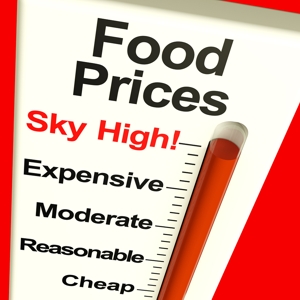
Bad news for hungry Canadians: Canada’s Food Price Report for 2026 is out. And the bottom line is, we’ll be paying a lot more for food again this year. The average family can expect to lay out at least $1,000 more for food over 2026…

“Canada’s Food Price Report 2026 predicts Canadian families will spend up to $994 more on food [this] year. One-quarter of Canadian households are considered food insecure.”
Stark statements about a grim situation: a dark subtitle to Canada’s Food Price Report 2026.
By the numbers…
“Canada’s Food Price Report (CFPR) 2026 forecasts that overall food prices will increase by 4% to 6%,” the introduction begins. “The average family of four is expected to spend $17,571.79 on food in 2026. […] Food prices are 27% higher than they were five years ago.”
In addition, Alberta, New Brunswick, Nova Scotia, Ontario, and Quebec are forecasted to experience food price increases above the national average.
A tradition, of sorts…
The annual CFPR has become a tradition of sorts. 2026 marks it’s 16th year. And the news has just been getting worse every year since the first.
“The CFPR is an annual publication produced collaboratively by Dalhousie University, Saint Mary’s University, University of Prince Edward Island, Cape Breton University, the University of Guelph, Uni-versité Laval, the University of British Columbia, and the University of Saskatchewan,” the Report’s preamble explains. “Each of these universities contributes to enriching the report’s scope and regional expertise.”
“The report provides readers with predictions on estimated annual food expenditures based on age/gender to improve their personal and household budgeting. The 2026 edition of CFPR used one broad, systemized approach to forecasting, employing a suite of predictive analysis models that factored in key regressors (such as climate change and geopolitical information).”
 US President Donald Trump’s crushing tariffs cut Canadians both ways in 2025.
Key factors
The report identifies a number of key factors influencing the price of food…
On the plus side, the Government of Canada removed Goods and Services Tax (GST) or Harmonized Sales Tax (HST) charges on select product purchases, including most food and beverages. This con-tributed to a large decrease in food inflation, dropping to -0.6% in January (the first time this has been a negative number in over eight years). Canadians theoretically spent much less on food over this two-month period.
However, other overarching pressures pretty much negated the effects of the tax ‘holiday’.
Those included:
- The US Tariffs dispute
- The Buy Canadian Movement (which saw some shoppers patriotically buying more-expensive Canadian-made foods)
- Interest rate cuts (benefiting the industry, but not average Canadians)
- Restrictions on Temporary Foreign Workers (which raised costs for farmers)
Food companies responding to pressures (which triggered restructuring and layoffs)
Beef prices continued to soar
The price of beef soared in 2025, with a 19 percent increase in the first quarter alone. This stabilized in later seasons, but prices were still up 23 percent from the five-year average.
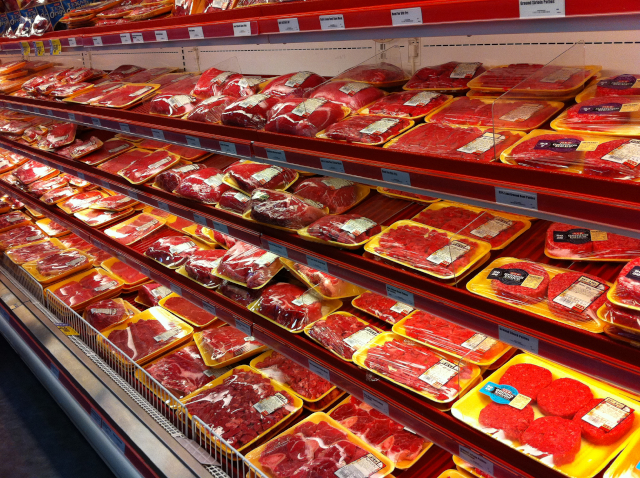 Supermarket meat department beef displays have shrunken
considerably since this 2020 photo was taken…
“While all food prices will experience slight increases, meat and beef witnessed the largest increase,” reports Dr. Stuart Smyth, Campus Lead, University of Saskatchewan. “Nearly a decade of drought in the leading beef producing area of Canada has resulted in the smallest number of cattle since the late 1980s. Reduced supply and consistent demand creates upward pressure.”
Global Warming a continuing threat
Climate change – in particular Global Warming – will continue to exert pressure on the food supply. “Increasingly severe and unpredictable weather events around the globe will continue to disrupt agricultural production.”
We’ve already seen some major indications of the havoc climate change is starting wreak on the world. Millions of Somalis are on the move again – as is their habit when food supplies disappear due to severe droughts.
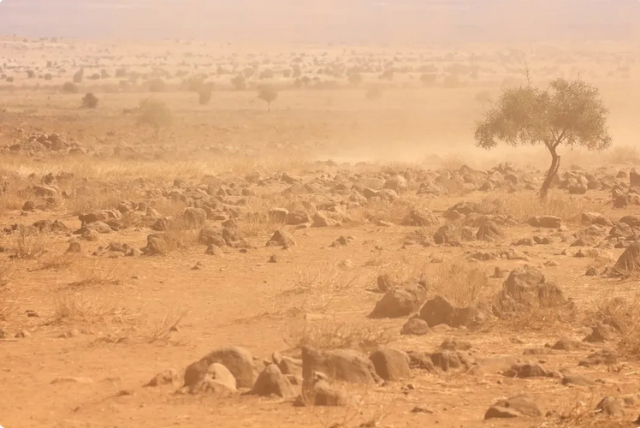 Millions of Somalis are on the move again, fleeing unprecedented drought…
Elsewhere – notably in the central US’s ‘Tornado Alley’ – unprecedented storms and torrential rains have caused severe disruption of life in general, and agriculture in particular. In Asia, heavier-than-usual monsoons have triggered unprecedented flooding.
A recent report by the US National Oceanic an Atmospheric Administration (NOAA) underlines the seriousness of the situation, and details the effects warming is already having on the world, it’s plans, and its animals – including humans.
My take
I doubt the food price situation will improve significantly by itself. Given the findings of the 2026 CFPR, it’s clearer than ever that, at some point, governments are going to have to force food retailers to sacrifice profits for the greater good. And the sooner, the better. Millions of Canadians – and lower-income folks everywhere – are already hard-pressed to put decent food on their tables. And the Food Banks expect the burden on their services to continue to increase at an unprecedented rate this year.
~ Maggie J.