
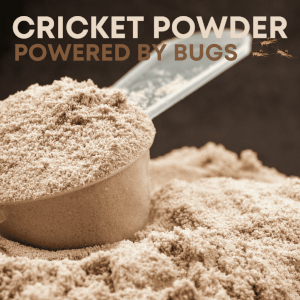
A Canadian company set up what was to be the biggest Cricket Farm in the world, in the 20-teens. But the insects-forward food production scheme succumbed before it really got going – due to nagging tech issues… And the ‘YUK’ factor…
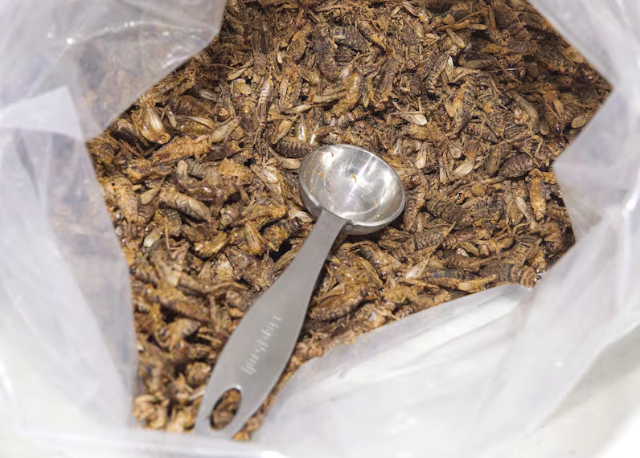 Aspire’s crop: Dried Crickets awaiting processing and packaging…
In the late 20-teens, Aspire Food Group Canada built a huge new farm near London Ontario. A cricket farm. The 150,000-square-foot hatchery was to be the world’s largest facility for raising crickets to be used as food – for animals and humans. It officially came online in 2022.
The fully automated ‘grow houses’ was designed to raise billions of insects and produce millions of kilograms of concentrated, healthy protein each year. But management as never able to make it work. It crashed after only about a year of ‘up time’. And went into receivership in 2025. The federally sup-ported enterprise went bust, never having operated at over 50 percent capacity.
Promising start…
The company started raising crickets in 2013, using a ‘manual’ process. But that scheme hit a pract-icality wall when it won the prestigious $1-million US Hult Prize, given annually for ‘the idea most likely to change the world’. At that point, it was clearly, ‘Go big or go home’.
Investors flocked to Aspire’s doorstep, and the Canadian Government pitched in with a sizeable grant. Mystery surrounds the financial demise of Aspire’s aspirations. The final sale price remains secret, and the final liquidation deal is sealed under a court order. Sounds like a lot of those involved are afraid of being embarrassed!
How much government (our) money may have been recovered remains to be revealed…
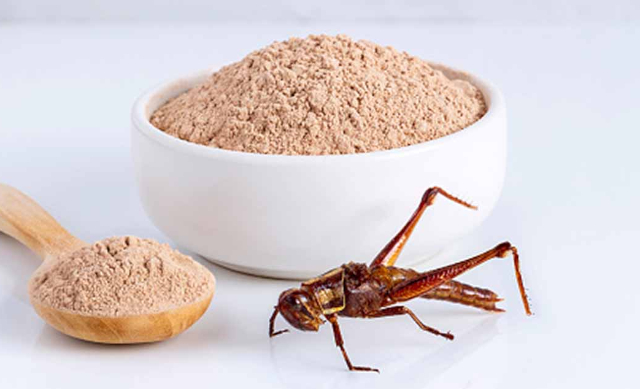 Before and after: Cricket protein ‘raw’ and processed…
What happened
Aspire came under simultaneous attack from three implacable enemies.
First, there were major problems with the new, automatic rearing and processing system. It was fraught with technical glitches and designs that just didn’t work as planned. They never did get all the wrinkles ironed out.
Second, there was what observers called the ‘Yuk’ factor. Potential consumers – human shoppers – shunned the very idea of eating bugs. No matter how processed, refined and purified the powdered protein product was.
Third… That old scourge of new products, high initial price, hit Aspire’s sales hopes really, really hard. Even if you liked the idea of cricket protein, the retail ‘launch’ price point of $49.99 per pound / $109.89 per kg was an immediate turn-off. That’s more than the average sticker on a pound of the most ‘premium’ beef cut on the market today.
My take
It appears the former Aspire facility is going to be back in the cricket business soon – under its new ownership. Halali Group Holdings says it intends to focus on ‘high-value niches within the insect agriculture market‘.
While Headquartered in London (coincidence noted), England, Halali Group’s cricket enterprise is incorporated in Canada has a private limited company. We’ll keep you posted on their progress…
I am optimistic that the large-scale commercial production of high-quality, highly-nutritious cricket protein in Canada will succeed. Just not soon. Everything about Aspire said ‘success’! Everything but their timing. I think Aspire was simply 20 or, maybe 20 years at most ahead of their time.
We’re in that transitory, switch-over stage between animal and plant protein as our global go-to source. We just haven’t reached the point where the change has become an everyday necessity.
And, of course, Halali will have to do something about the $50 per pound price point, too! But con-sidering that Aspire never even got up to 50 percent of planned production capacity, while saddled with $41 million in debt… I’m confident Halali’s cautious approach to the market will one day win the day…
~ Maggie J.