
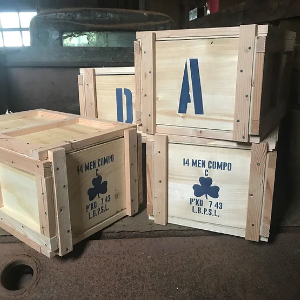
Canadian troops went ashore on D-Day, 80 years ago today, with a standard battlefield food issue: the Composite, or ‘Compo’, Ration. The Compo Box became a legendary fixture at frontline mealtimes…
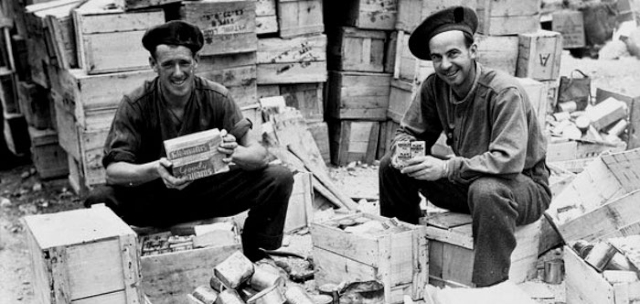 Canadian soldiers with a pile of freshly arrived ‘Compo’ Rations
at a forward supply depot at Cassino, Italy, April, 1944…
My birth Dad, Charlie, never talked much about his experience as a forward recce Trooper clearing the Channel Ports after D-Day. But when he did, his remarks were often focused on what he and his comrades in arms were given to eat in the field.
The ubiquitous Compo Box
The standard Composite, or Compo’, Ration was a sturdy wooden crate filled with ‘everything required to feed 14 men for one day, or 1 man for 14 days’. But it was a much more complex affair than it might sound!
The Compo box held more than 5 dozen separate items – tins, packets and pouches – containing a wide array of culinary products. Principle among them, in a mid-range menu, were Biscuits (hard crackers which became easily chewable only after dunking in the ever-present Tea), ‘Bully Beef’ (Canned Corned Beef), and canned vegetables.
But there were also margarine, cheese, sardines, ‘Boiled Sweets’ (hard candies – made, somehow, without sugar, which was closely rationed), and a chocolate bar per man.
Among the non-food items included were toilet paper (“Never enough!” Dad would lament), matches, soap… and cigarettes. Indeed, many a young man got started on ‘the weed’ in the service of Queen and Country.
Special significance
The chocolate was meant to give a quick energy boost when a fighting man needed it. But the bars were often gifted to civilians who Dad’s ‘point-of-the-spear’ unit liberated.
In fact, when they liberated Holland (now, the Netherlands), Dad’s regiment found the people starving. The retreating Germans had confiscated all the food they could find. Civilians were boiling up tulip bulbs and chewing on shoe leather to survive. Without hesitation, the 12th Manitoba Dragoons gave over their Compo Rations as relief aid. That kind of gesture is just one reason Netherlanders have such strong affection for Canadians to this day.
Different menus
The Compo boxes came in various versions, starting at the top with the coveted ‘A’ packs. They contained canned bread, canned beef stew, and other rare delectables. Soon after D-Day, quar-termasters found they had to battle other functionaries in the supply chain to ensure that all troops got their fair share of the bounty.
The ‘quality’ of Compo Boxes, however, declined the farther down the alphabet their designations ranged. The ‘E’ Compos, at the bottom, were described by many disappointed solders as consisting mainly of Sardines, Biscuits and the ever-present, universally despised powdered Tea mix.
Just as a matter of course, the ‘A’ boxes tended to go to the higher ranks, behind the lines, while the less-desirable ‘menus’ were sent ‘forward’ to the fighting troops.
Canadians vs. Americans
There was one key point on which Canadian and Empire rations differed from those issued to their American counterparts in the Western European ‘Overloard’ campaign.
And it was considered a mark of distinction by the Canadians. While they complained about their food allotments, the Canadians, Dad stressed, always felt they were lucky to get Corned Beef. The Americans were universally issued SPAM, the (in)famous spiced pork product, which was considered decidedly inferior.
The bottom line…
One of Dad’s most frequent observations about his battlefront rations summed up the situation beautifully: “Everybody complained, but nobody starved!”
My take
Let’s all take a moment to remember the ‘boys’ who went to war in 1944. And while you’re at it, remember that some Brits had been ‘in it’ since late 1939. Canadians served in the Italian campaign before D-Day. In total, half a million Canadians, all volunteers, took part in the Second World War. My dad was one of those lucky enough to come home in one piece…
~ Maggie J.