
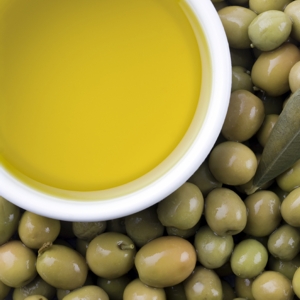
‘The right oil to use’ is a universal concern among cooks – from weekend ‘BBQ masters’ to Executive Chefs at the loftiest 5-star restaurants. But it seems that, as many times as I’ve covered the issue, there are still some folks who haven’t got the message…
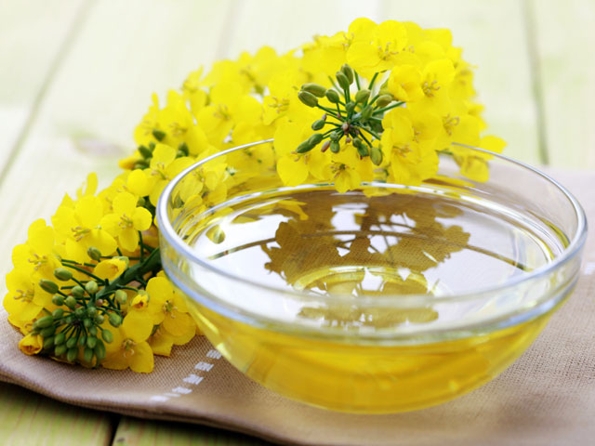 Canola blossoms: And a beautiful bowl of the versatile golden oil their seeds produce.
There are two kinds of cooking where oil is used: frying and everything else. And there are plant-based and seed oils suited to all of those applications…
Best for Frying
Frying is, by definition, a high-temperature operation. So, oils with a high ‘smoke’ (burning) point are absolutely essential.
The most common of these include:
- Canola Oil
- Peanut Oil
- Sunflower Oil
- Safflower Oil
- Soy Bean (‘vegetable’) Oil, and…
- Avocado Oil
Avocado Oil?
Not one of the most talked-about cooking oils, but one that’s coming more into vogue among pro cooks these days. And they have their reasons.
“Unlike seed oils, avocado oil is not extracted from the pit of the fruit but from the flesh itself,” noted food blogger Stella Totino recently wrote. “Through a multi-step extraction process, the oil is separ-ated from the avocado solids, resulting in a slightly yellow-tinted, neutral-tasting oil with a high smoke point.”
With a very high smoke point between 500 F and 520 F, Avocado oil fills the bill generously.
But the cost factor…
… Will make anybody short of a financially independent ‘hobby’ cook flinch.
As I write this, various brands of avocado oil are selling, at my go-to supermarket, for anywhere from $2.00 to $2.40 per 100 ml. That’s a hefty $20.00 to $24.00 per litre. More, even than olive oil, which heretofore was the priciest cooking lube we’d discussed.
I just can’t see ever using it myself for deep or shallow frying, or any other application that requires a large volume of oil. I’d rather spend the money on the food I’m planning to cook in it. Nevertheless… There may be applications where you’ll find it indispensable.
Best for Baking
Here’s a category where personal preference plays a distinct role. There are occasions when you’ll want a neutral-flavoured oil (canola oil), others where you’ll be looking for a down-home, ‘golden-kissed’ rich flavour (corn oil), and others still when you’re making something savoury, such as Focaccia or Ciabatta, and only genuine olive oil will do.
Best for Sauces and Dressings
For dressings, you’ll often choose olive oil for its distinctive flavour and greenish-gold colour. But there may be times you want a neutral-flavoured oil that doesn’t clash with the flavourings you’re using. Then, a little dab of canola will do you. Unless you want the specific flavour of Sesame Seeds, Peanuts, Walnuts or other ‘exotic’ oils.
The same general rule also goes for sauces. But you’ll probably look no further afield than olive or canola oil for ‘cooked’ preparations.
‘Vegetable’ oil?
It’s usually predominantly inexpensive soybean oil, but may be a blend including others less-costly oils such as canola or coconut. And it’s long been touted as an ‘all-purpose’ cooking oil. But there are some drawbacks to this otherwise convenient choice.
Blends may contain unhealthy oils such as the aforementioned coconut, along with palm oil, or ‘partially hydrogenated’ oils that contain saturated fats or transfats.
The ‘seed oils’ debate
There has been a lot of chatter online and in the culinary community about ‘seed’ oils in general, lately. But the latest science exonerates seed oils of the evils they were thought to possess. And it’s wise to remember that seed oils (some more so than others) are rich sources of vitamins, minerals and bioactive nutrients.
My take
That’s the straight-up low-down on cooking oils, across the board.
Incidentally… It’s occurred to me that the folks who were heretofore uninformed on the differences between oils may, in fact, be new cooks or younger folks just getting into the culinary community. Thanks, Erin, for suggesting that angle!
One final note: I always have three oils close at hand when I’m cooking: Corn (for baking), Canola (for frying) and, Olive for all things savoury…
~ Maggie J.