
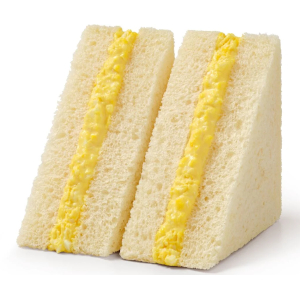
No sooner did we expound upon the revered Tamago Sando – the traditional Japanese Egg Salad Sandwich – than 7-Eleven announced its convenience-store Japanese Egg Salad Sando is coming to Canada! The Mind Pirates are back in my head…
 The coveted 7-Eleven Japanese Egg Salad Sando: Preferred at least 4 to 1 over Roast Beef!
There are more 20,000 7-Eleven stores in Japan. No joke. And they have a much larger footprint than their North American counterparts. That’s because they carry a far wider variety of products.
“They go way beyond the standard hot dogs and pizza you can find at American locations, offering a wide array of bento boxes, desserts, sandwiches, and even fresh baked goods,” Chowhound reports. “You’ll find classic Japanese foods like onigiri and karaage, but many customers contend that the best dish in the whole store is an egg salad sandwich.”
Fundamental differences…
The 7-Eleven Egg Salad sando (the Japanese word for ‘sandwich’) (see photo, top of page), embodies several fundamental differences from its nearest North American equivalents.
Chowhound contributor Elias Nash explains… “The egg salad at Japan’s 7-Eleven stores is packed with a secret ingredient that takes it over the edge: Kewpie mayonnaise. It’s a unique Japanese brand that’s quickly spreading around the world, and chefs are obsessed with it.” The main secret to the mayo, in turn, is that it uses only the egg yolks. But there’s more to it than that.
Google AI condenses Kewpie Mayo into a few well-chosen words: “[It’s] a popular, rich, and tangy Japanese mayonnaise, first produced in 1925, known for its distinct creamy, custard-like texture and deep savory flavor (umami). Unlike Western mayo, it uses only egg yolks instead of whole eggs and features a unique blend of apple cider or rice vinegars with MSG, making it ideal for sushi, salads, and dips.”
Meaning, it’s really different from what we in the West call ‘mayo’. Which is not to say, it’s less ap-pealing than our snow-white product. In fact, I’ve tried making my own, according to an allegedly authentic recipe I found. And if anything, I found Kewpie more flavourful and delicious. On the other hand, I wouldn’t use it in most of the applications I now use ‘regular’ white mayo. The flavour just wouldn’t ‘go’ in those dishes.
A ‘living’ legend
The 7-Eleven Egg Salad sando is actually a mass-production-adapated version of the ancient and venerable classic Japanese Tamago Sando. The Tamago Sando is pretty finicky to make properly, and just doesn’t lend itself to mass marketing. But the 7-Eleven version captures the essential flavour and texture Japanese fans want – cherish! – in their egg salad.
As such… 7-Eleven has become a dining ‘destination’ of sorts. It’s gone ‘platinum-viral’ on Japanese social media platforms. And store operators can’t keep it in stock. It’s become a bona fide ‘living legend’.
My take
I’m eager to see how strongly the 7-11 Egg Salad Sandwich catches on with North American fans. I have a few (minor?) observations that cause me doubts.
First, the Chowhound story mentions – just in passing – that, “There’s another ingredient in Kewpie that makes a huge difference: monosodium glutamate aka MSG. It’s pure umami, adding an extra dimension to egg salad that other mayo brands cannot.”
“Unfortunately, Americans have long laboured under a myth about MSG being harmful (which may be rooted in anti-Asian prejudice). Consequently, the Kewpie mayo sold in the United States is made with yeast extract instead, which contains some natural glutamate, but not as much as MSG. The American version also adds sugar, another departure from the original formula.”
Without the umami boost given the Japanese version – and the addition of sugar which could blur or submerge some of the more-delicate nuances of the Japanese original – I fear North American aud-iences may not flock to the product in the droves 7-Eleven envisions…
~ Maggie J.