
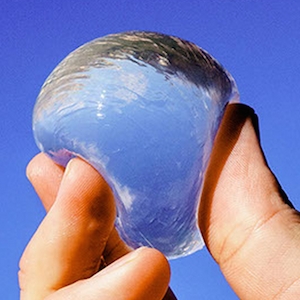
The UN has issued its latest update on the global water situation. A pivot point has been reached. The report says what was previously a crisis has become a permanent shortage. And global water management policies must change…
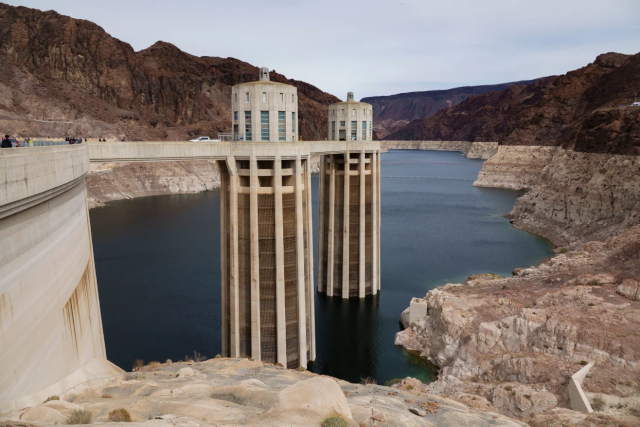 The Hoover Dam along the Colorado River on March 14, 2025: A permanent shortage…
The world has gone beyond a temporary water crisis to a permanent water deficit. The UN’s latest situation report calls it a state of ‘water bankruptcy’…
How it is…
“For much of the world, ‘normal’ is gone,” Kaveh Madani, Director of the UN University Institute for Water, Environment and Health, told reporters. “This is not to kill hope, but to encourage action and an honest admission of failure today to protect and enable tomorrow.”
According to the official news release, “The report introduces water bankruptcy as a condition defin-ed by both insolvency and irreversibility. ‘Insolvency’ refers to withdrawing and polluting water beyond renewable inflows and safe depletion limits. ‘Irreversibility’ refers to the damage to key parts of water-related natural capital, such as wetlands and lakes, that makes restoration of the system to its initial conditions infeasible.”
But Madani insisted that bankruptcy is not ‘the end’. As Winston Churchill said, in 1940, of the end of the Battle of Britain: “Now this is not the end. It is not even the beginning of the end. But it is, per-haps, the end of the beginning.”
“It is the start of a structured recovery plan,” Mandami stressed. “You stop the bleeding, protect essential services, restructure unsustainable claims, and invest in rebuilding.”
Unmistakable signs
According to the study, more than half the world’s large lakes have declined since the early 1990’s, while around 35 percent of natural wetlands have been lost since 1970.
Nearly three-quarters of the world’s population live in countries classified as water-insecure or crit-ically water-insecure. And around four billion people experience severe water scarcity for at least one month each year, while drought impacts cost an estimated (US)$307 billion annually.
Other glaring indicators of water bankruptcy include, “shrinking rivers and lakes, dried-up wetlands, declining aquifers, crumbling land and sinkholes, the creep of desertification, a dearth of snow and melting glaciers,” A CNN report last week noted. Add to that, Mexico City is sinking as underlying groundwater is extracted. The Arctic and Antarctic ice packs are disintegrating. And humanity’s demands on its water supply continue to increase.
What’s to be done?
The report declares that the solution to the water bankruptcy requires, “a transition from crisis response to bankruptcy management, grounded in honesty about the irreversibly of losses, protection of remaining water resources – and policies that match hydrological reality rather than past norms.”
My take
I never thought I’d live long enough to see all the dire warnings about climate change, food insecurity and, now, global water bankruptcy borne out in my everyday reality. But there you are. As Alvin Toffler said, back in the 1970s in his book Future Shock, it’s not change that’s pushing the world toward calamity. Not even the rate of change. But the rate at which the rate of change is accelerating. Therein lies the shock.
The plane is going down. We must all ‘Brace!’ for impact. But at the same time, we must maintain our faith in the pilots to save us from the impending disaster…
~ Maggie J.