

Call this ‘Underfilled Grocery Products 2.0’ I posted last week on shopper complaints about under-weight Loblaw’s grocery products. Now, there’s more on the contentious story. Such complaints increased 140 percent in the past year!
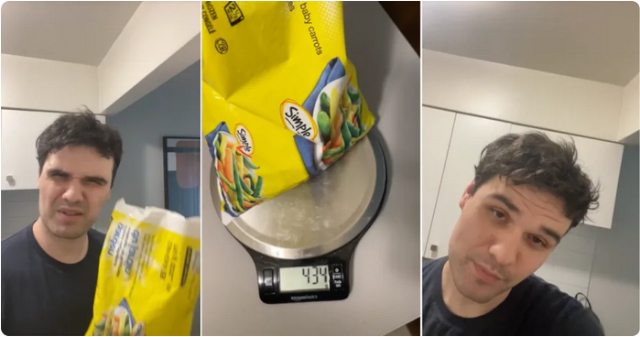 Shopper Jake MacLellan posted proof that his 800 g bag of Loblaw’s
No Name brand frozen veggies was only about half full…
The story up to now…
A Loblaw’s shopper posted a video recently showing that a sealed bag of frozen veggies he just bought was only about half the weight printed on the label. But that was just the latest such episode involving Loblaw’s house brand products. Previously, other shoppers had posted about short-weighted items they had purchased at Canada’s largest supermarket chain.
I looked at the complaints as objectively as I could, leveraging my experience in retail (albeit years ago) and knowledge of the packaging industry in analysing the situation. And concluded that the incidents were probably isolated, and the result of errors (mechanical or human) on the packaging lines.
But commenters, like the posters, were adamant that Loblaw’s (and other food retailers) were deliberately and systematically shorting consumers on the weight of many products. I thought that was highly unlikely, a knee-jerk reaction from frustrated, angry shoppers.
But I was wrong
New figures from the Canadian Food Inspection Agency (CFIA) confirm that consumer complaints of short-weight products increased by almost 150 percent from May 1, 2023 to April 30, 2024.
That’s got to be more than a coincidence! In the past month alone, CIFA received 8 complaints. I always follow the ‘100%’ Rule. That is, for every complaint filed, there are at least 100 other folks out there who shared the same experience but were either too apathetic or too resigned to the situation to report it.
CFIA justifiably concerned
“The CFIA takes these issues seriously and wants to know about products that consumers think are labelled as misleading,” the agency said in a statement to Global News.
Under the Safe Food for Canadians Act, it is prohibited to, “manufacture, prepare, package, label, sell, import or advertise a food commodity in a manner that is false, misleading or deceptive or is likely to create an erroneous impression.”
The Act further specifies: “It is mandatory that the net quantity on the label accurately reflects the contents of the package, and that the labelled weight does not include the packaging itself so the net quantity must reflect only the net quantity of the food,” the spokesperson said.
That covers everything from underweight groceries to those ‘overstated’ burgers that Burger King was taken to court about last year.
What happens now?
The CFIA has protocols that mandate investigation of substantiated consumer complaints. The agency notifies the manufacturer or importer, requests corrective action, conducts additional inspections including further targeted sampling, seizing of products and requesting recalls.
My take
I don’t know why the CFIA didn’t send up a flare to consumers over the surge in complaints about short weighted groceries. But I think they might not have wanted to warn the grocers they were coming. Giving the supermarketeers the chance to remove the suspect goods from their shelves before investigators arrived. Or maybe I’ve just been watching too many conspiracy movies…
Nevertheless… There’s something going on with underweight grocery products. And I’m anxious to see what the CFIA discovers…
~ Maggie J.