Restaurants and food delivery services have come under fire in the past year or so for hammering on customers to proffer gratuities. Digital tipping screens have only made that easier – and more annoying.

So, it’s no surprise that somebody has surveyed the great American public on their current feelings about tipping. And the results are surprising. At least to me…
More or less independent
Bankrate is a financial product ‘comparison service’ which provides ‘objective information and actionable next steps to help you make informed decisions’. But it is advertiser-supported, and ‘does not include information about every financial or credit product or service’. We could expect some biases. But their recent poll on tipping seems totally detached from any commercial influences…
Key findings
The survey on tipping culture reveals, “59 percent of Americans view tipping negatively, down from 66 percent in 2023. This includes people who feel businesses should pay employees better, are annoyed about pre-entered tip screens or would be willing to pay higher prices to be done with tipping.”
In addition, “35 percent of Americans believe tipping culture has gotten out of control.” That’s an increase from an even 30 percent last year. However, considering the decrease in the number of folks who ‘view tipping negatively’, it seems as though consumers may be coming to some sort of accommodation with the new extortion-based tipping model.
The details…
- Restaurant servers are most likely to receive tips. In addition to being most likely to receive tips (with 67 percent of restaurant-goers saying they always leave tips at sit-down restaurants) compared to workers in other industries, tipping is also up for servers since 2023 (65 percent).
- Home repair workers are least likely to receive tips. Ten percent of customers always tip home services/repair people, the same as last year.
- Tipping for hair stylists/barbers, food delivery people and taxi/rideshare drivers is up from last year. Meanwhile, tipping for hotel housekeepers, coffee shop baristas, furniture/appliance delivery workers and takeout food workers is down from 2023.
- Negative opinions about tipping rise with age. Forty-five percent of Gen Zers, 51 percent of millennials, 62 percent of Gen Xers and 72 percent of boomers have at least one complaint about toward tipping.
- Women are generally more likely to tip than men. Among those who use each type of service, women are more likely to always tip than men for most workers except coffee shop baristas (with 19 percent of men and 20 percent of women always tipping), furniture/appliance delivery workers (16 percent of men versus 15 percent of women) and home services/repair people (10 percent of men versus 9 percent of women).
Specific points…
Bankrate shares some ‘expert’ observations on the way tipping culture is evolving.
‘Notably, only 23 percent of Gen Zers and 27 percent of millennials think tipping culture has gotten out of control, as opposed to 40 percent of Gen Xers and 46 percent of boomers. Could younger folks be more used to modern tipping culture, while older generations remember it differently?”
“A millennial, tipping customer and former server, notes that the minimum tip suggestion for counter service [now] seems to be 20 percent, and can run as high as 30 percent. She shares that when she worked at a counter — as opposed to serving tables — she only expected tips of 10 percent.”
“A majority of people (64 percent) say the amount they tip is most influenced by the quality of service. But 10 percent say they always tip the same amount regardless of the quality of service. Boomers (76 percent) and Gen Xers (67 percent) are much more likely than millennials (55 percent) and Gen Zers (50 percent) to say their tip depends on the quality of the service.”
My take
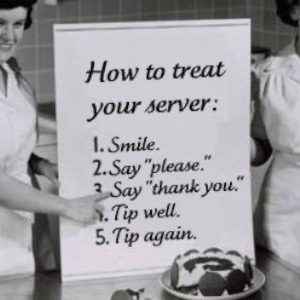
Disclaimer: I’m definitely an old-school tipper. (See image, top of page.) I firmly believe tips should not depend on any factor except the service the person to be tipped has provided. I rebel at the notion that tips should be mandatory in any way. Nor should they be ‘suggested’, in any case. And I am revolted by management types who control tipping at their establishments, and keep all or even part of the digitally-gathered tips for themselves. That being said…
I agree, on the whole, with the general observations above. But I have some difficulty with the fact that almost 10 percent fewer folks ‘viewed tipping negatively’ compared to last year. Frankly, I’d have expected a 10 percent increase, given all the media chatter the topic has been generating.
Be that as it may… I think it’s fair to say we haven’t heard the last of Tipping Fatigue…
~ Maggie J.