
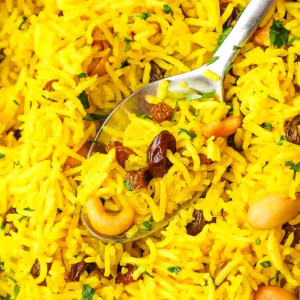
It’s none other than one of the Top-10 Indian dishes ever brought to Europe and North America: Yellow Basmati Rice! Basic Basmati showcases some of the most fundamental Indian ingredients. And it’s not as difficult to make as you might have thought…
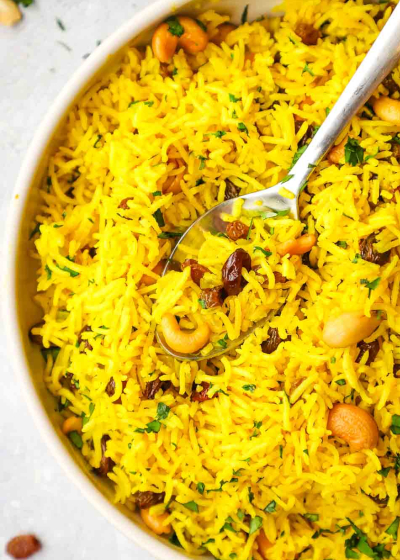
This delicious colourful subcontinental staple has many endearing character-istics. Not the least of which is, it can complement any spicy Asian Dish you choose to pair it with.
And in keeping with the current [and persisting] ‘sweet-spicy’ trend, it offers a taste of both, pairing yellow curry with yellow raisins.
But there’s more…
It’s also a healthy dish, brimming with Turmeric – one of the classic Eastern spices identified in the past few years as ‘super foods’.
Yellow Basmati Rice may be the ulti-mate starter dish to introduce novices to the wonderful world of Indian cuis-ine. The ingredient list is a veritable all-star cast of classic Indian components including…
Basmati Rice
There are several kinds of rice that are commonly used in various Indian dishes. Each has it’s purpose in the dish. You’ve probably heard of some, such as Basmati, Jasmine, Brown, and basic long-grain White rice? They’re just the most commonly used of more than 20 types of rice called for in authentic recipes treasured across the 23 official Indian culinary regions.
Yellow Onion
Yellow Onion is the classic type used in the majority of Indian dishes. It’s medium-sweet and not to ‘hot’. Gets along with everybody.
Yellow Curry Powder
Yellow curry is just one of many regional curry styles, each defined by it’s own colour and constituent spices. It’s the first curry that many westerners are exposed to. It’s a bright, bold, tangy curry with earthy undertones, whose lead player is Turmeric. Which is responsible for the characteristic yellow colour of most ‘yellow’ Indian foods.
Turmeric
And even though today’s recipe relys on pre-mixed Yellow Curry powder for its base flavour, it also calls for even more Turmeric, to bolster the unique yellow curry experience. Turmeric has been credited with a long list of health benefits. It’s said to support joint health, boost brain health, aid digestion, display potential anti-cancer properties, support liver health, and support heart health by improving blood vessel function, reducing cholesterol levels, and reducing blood clots.
Vegetable Broth
The majority of Indian dishes are vegetarian or vegan. And that makes it all the more important to always have veggie stock/broth on hand of you ‘cook Indian’ regularly. You can make your own easily and quickly, in large batches, and freeze it in recipe-sized portions. It’ll keep for several months without losing its punch. And homemade is much cheaper than buying it by the box from the store.
Cashew Nuts
Where the peanut is the classic, ubiquitous nut in African and Southeast Asian cuisine, cashews are king in Indian cooking. Indian recipes may call for raw, roasted, or toasted Cashews. As it turns out, Cashews are also pretty healthy: low in sugar and rich in fiber, heart-healthy fats, and plant protein. Also a good source of copper, magnesium, and manganese — nutrients important for energy pro-duction, brain health, immunity, and bone health.
Cilantro
The bright, floral ‘parsley alternative’ much of the rest of the world prefers. It’s used as both a fla-vouring herb and a garnish across Asia, as well as in south and Central America. Another Indian staple…
The recipe
The full recipe is available, along with fascinating ingredient and prep tips, at Our Healthy Mess. It’s important to note that the basic techniques outlined at this site apply equally to the preparation of Basmati rice for any Indian recipe. The site’s recommendations for ensuring you get light, fluffy, separate-grained rice every time are particularly helpful…
My take
Once you’ve mastered the classic technique for preparing Basmati Rice, and familiarized yourself with the basics of India’s most-basic curry, you have a firm foundation for further exploration of one of the world’s most varied and healthy cuisines!
~ Maggi J.