

There may be no other dessert that’s more beloved by Italians than Cannoli. As one native food blogger puts it, “Cannoli isn’t just a dessert for guests to enjoy; it’s an homage to the history of Palermo.” And it’s changed as it travelled…
There’s a famous – cult-favourite – scene in The Godfather films in which a couple of Corleone family ‘torpedoes’ take a victim out to the wilds of New Jersey to pop him. They stop at a bakery on the way. After the execution, the senior hit man tells the junior guy: ‘Leave the gun, take the cannoli.”
Author Mark Seal wrote a book about it: Leave the Gun, Take the Cannoli: The Epic Story of the Making of The Godfather (Simon & Schuster).
“It’s about the gun, but even more it’s about the cannoli,” Seal said. “It’s about the family. That’s what makes ‘The Godfather’ so enduring — and strangely endearing. You end up becoming part of this family.”
And it’s a totally authentic expression of Sicilian culture. The Cannolo (proper singular form of the name) originated in Palermo around 1000 AD, even before Sicily was officially part of Italy. The island was, in fact, an Arab Emirate. And the name ‘Cannoli’ comes from an Arab word for ‘tube’.
Crucial differences
What many fans don’t know is, the original Cannoli recipe is somewhat different than the one that’s popular in North America. The blunt-ended, vanilla custard-filled ones are a later, Venetian variation.
Italian-American food blogger Gabby Romero went to the source for taste of the original cannolo, and discoveded an authentic piece of Sicilian history.
“At the historic hotel Villa Igiea, cannoli isn’t just a dessert for guests to enjoy; it’s an homage to the history of Palermo,” she declares.
‘Real’ cannoli are, in fact less sweet and much more flavourful. “Italian-American renditions of cannoli are often pretty sweet, even without the mountain of powdered sugar sprinkled over the top. But when you go back to the motherland, the crispy [deep] fried pastry has a lot more nuance. […] The Sicilian [filling] recipe blends cinnamon, coffee, and cocoa for added layers of depth.”
A different look
Traditional cannoli are also different in appearance than the ones you see abroad – except maybe for little Italy, where traditional bakers still rule.
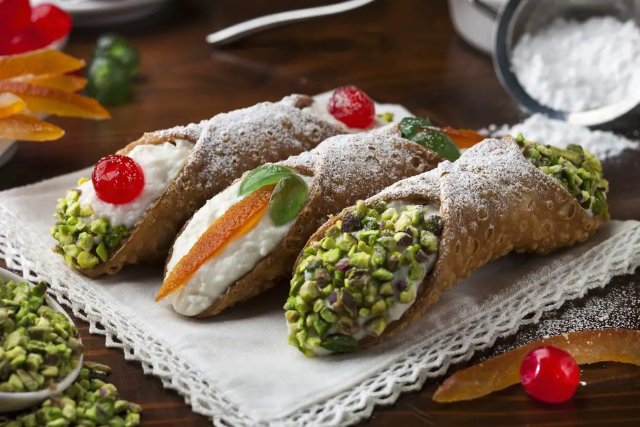
First off, those deep-fried crispy shells are somewhat darker amber than the ones you see across the ocean. They’re made by wrapping the pastry dough diagonally around a dowel. So the ends come out pointed and the overall side view features slanted ends pointing to a round, fat centre section. The surface is bobbly and delicate, and the edges are lacy.
The rich cream filling is piped right out to the ends and topped with all sorts of goodies. Like an American ice cream sundae.
A cloistered history
Cannoli were, at first, treats enjoyed by the rich and royal. Fittingly, the secrets of cannoli making were guarded by religious orders. But as the ingredients required became cheaper and more plentiful, more folks got into the business.
“At their peak in the 18th century, it’s believed that there were as many as 21 convents making pastries in the capital city of Palermo,” Romero notes. “Only a few are still up and running today.”
But today you can get real-deal cannoli at almost any Sicilian bakery. And on mainland Italy, they’re all over the place, often styled as ‘cannoli siciliani’.
My take
I’ve made cannoli a couple of times, just to see how the process unfolds. It was easier and simpler than I first thought it would be. But the ones I made were the blunt-ended, vanilla-sweet ones favoured on my side of the Atlantic. I think I have to go back, now, and try making some according to the authentic recipe!
~ Maggie J.