
A post I recently came across begged me to ignore it – on general principles, as a professional cook. But I had second thought about bringing you my take, as a sort of refresher on the basic issues ad-dressed. I’ve chosen what I consider their most important items…
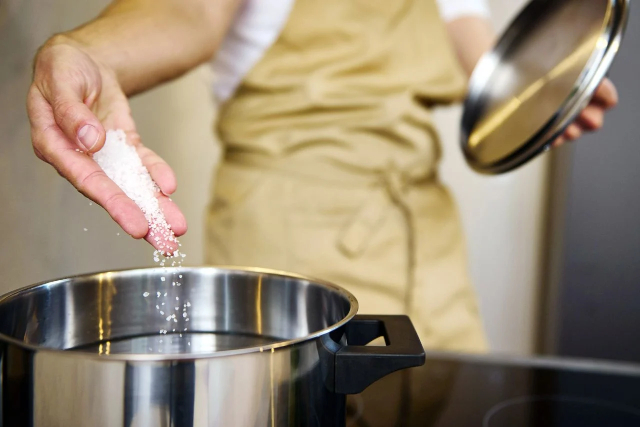 Any traditional Italian cook – including such Food Network stars Alex Guarnaschelli
and Giana De Laurentis – will tell you to salt your pasta water until it ‘tastes
like the sea’. At least one pro chef says that’s not really necessary…
There are some ‘rules’ that a cook comes to take as ‘gospel’ over years of practice. And as such, we don’t question them. But should we?
Current wisdom?
“Conventional kitchen wisdom can offer helpful structure for cooks at any level, but it can also pre-vent you from questioning the ‘why’ behind the ‘what’,” Food & Wine contributor Joy Chen tells us. “Because many rules are meant to be broken (or at least bent), we asked professional chefs across the country for the cooking ‘rules’ they never follow, especially when they’re off the clock.”
I’ll preface the ‘rundown’ with this observation: I am including only those the polled pros that I disagree with…
Always preheat the oven
“Unless I am broiling and attempting to achieve a quick brown on an ingredient in a short period of time, I usually skip this advice entirely,” says Noly Lopez, executive chef at Gather Restaurant in Yarmouth, Maine. Case in point: braised meats. “There is no inherent benefit [to] starting at a base temperature my product isn’t at anyways, and there is good science to suggest [a] slow buildup benefits most proteins during this cook time,” he explains.
My take: I guess Noly doesn’t bake, at all! It’s essential to preheat your oven when baking anything. Especially short pie crust. And you should always pre-heat whenever a recipe says so!
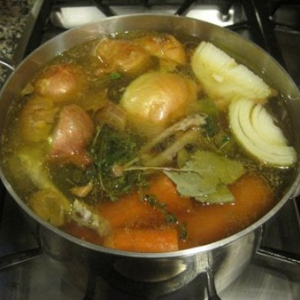
Simmer ‘gently’ for clear stocks
“[Real Stock] has a milky colour, thicker viscosity, and richer flavour with all the marrow, fat, and col-lagen [getting] emulsified into the stock,” says Kim, who notes that both clear and milky stocks have their place in the culinary world. “Choose your adventure with whatever dish you’d like to create, because boiling stock is not wrong, just different.”
My take: ‘Boiling stock’ isn’t just different, it’s wrong. The best stock results from a long, spirited, rolling simmer. But I agree with Ji Hye Kim, chef-owner of Miss Kim and Little Kim in Ann Arbor, Michigan, when she says ‘real’ stock is opaque, rich and colourful. If you want consommé or luxe ‘broth’ simmer ‘gently’. They are, in a large measure, more for ‘show’, and contain far fewer nutrients and flavours.
Salting pasta water ‘like the sea’
Rob Rubba, chef-partner at Oyster Oyster in Washington, D.C., says it’s wrong to salt your pasta water until it tastes ‘like the sea’. He insists the salt in the water infiltrates the pasta more as it cooks. It can be too salty by the time it’s done. He does, however, recommend – as do Food Network stars Alex Guarnaschelli and Giana De Laurentis- that you ‘finisih’ your pasta by adding it to sauce in the pan.
My take: I always finish my pasta by cooking it ‘the last mile’ in with the sauce. It makes a world of difference in the overall pasta experience! But Rubba must not do much Pasta with Oysters. You really do need to salt your pasta water liberally, to ensure it’s not bland and does cook properly.
Follow exact recipe measurements
“Instead of focusing on the exact amounts, I focus on the intention of the recipe,” Lopez advises. “Ratios are important here, and a good understanding of what each ingredient is contributing allows me to adjust in real time as needed.”
My take: I agree with Lopez in general, but I disagree, strongly, in one extremely important case: Any chef will tell you to add salt by the pinch, not by the measuring spoon. While recipe amounts may be a good guide for you. It’s been my practice, since I learned it as culinary school to salt during cooking by intuition. And add more at the end, if tasting dictates.
Never cook with extra-virgin olive oil
Lawrence Weeks, chef-owner of Murray’s Creole Pub in Louisville, Kentucky, says, ‘Go ahead and cook with Extra Virgin Olive Oil (EVOO)!’
My take: I love using EVOO in dishes which have a delicate flavour that will be complemented by a really good olive oil. But it’s a total No-No to use it for any high-temp application – especially frying! Weeks says his chosen EVOO has an even-higher smoke point than some ‘vegetable’ oils. And he reg-ularly sautées in it. I wouldn’t risk it…
My overall take
Many of my disagreements with the above-cited pros are, indeed, conditional. That’s a good point to make, here. Cooking is more an art than a science. As much technique as hard-and-fast rules. Always keep that in mind when you’re standing in front of the stove. Especially when you’re tinkering with your own recipe creations!
~ Maggie J.