

With all the concern – in the most extreme cases, rage – over high food prices, the Fast Food sector has been singled out as a major bad guy. With Burger fans in mind, a market research group has mapped Big Macs from cheapest to most expensive…
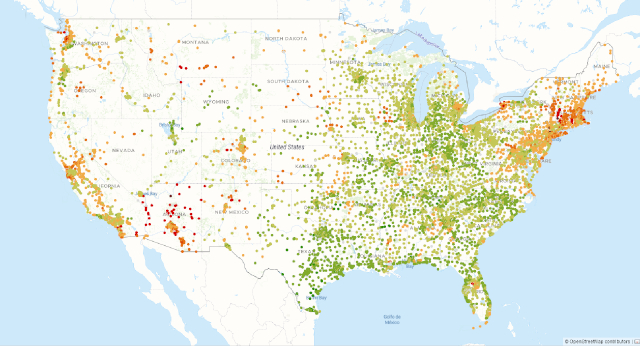 Short on details, but long on implications: The Pantry and Larder master reference to
the cost of a Big Mac across the US. Each location is a dot. Price ranges are
identified at 5 levels: lowest in dark green; highest in purple.
(Click on the image above to visit a larger, interactive version of the map…)
Takeaways…
The comprehensive plot of towns and cities, according to the cost of a McDonald’s burger in each, tells a curious story of regional differences. Both in what it costs to serve a burger, and what the market will bear in various locales.
Notice, particularly, the concentration of lower prices in the midwest – closest to McHeadquarters in Chicago, whence many supplies are shipped. Note also the concentrations of high prices (red dots) in Washington State and New England, as well as San Diego and San José California – where affluent clientele can be charged more without complaining. And New Mexico and Arizona, where a lot of wealthy sun-seekers reside.
In other statistical realms, I was shocked at how few McDonald’s locations there are east of the Rockies and west of the Mississippi. They’re concentrated -naturally, I assume – in the east, where the population is concentrated. And closer to Chicago.
First things first…
The cheapest Big Mac in America was just $3.49, in Stigler, Oklahoma. The most expensive was in Lee, Main, at $8.05
How, you must be asking, can there be such a broad price spread? There are a whole lot of contributing factors…
What goes into the price?
Cost of ingredients is primary. In McDonald’s case, ingredients are trucked to individual locations across the land from approved suppliers. Transportation costs can vary based on fuel costs, distance travelled, driver wages and benefits, and other variables.
Cost of branded materials includes drink cups, wrappers and bags, and utensils of all sorts. Anything used to package or serve a McFood item. And don’t forget signage and employee uniforms They’re all provided centrally by the head office in Chicago, under an exclusive contract with franchisees and managers. Transportation costs vary according to distance from Chicago.
Local operating costs include taxes, utilities and insurance, waste removal, and building and equipment maintenance. These costs vary from municipality to municipality.
Wages and payroll taxes and other employee-related expenses vary largely according to the local minimum wage.
Profit may be the last consideration some operators consider. But it’s an essential concern. That’s what resto proprietors are ultimately in business to generate. Some menu items have a profit margin of around 5 percent. On the other ens of the continuum, fountain drinks and fries may have profit margins as high as 70 or 80 percent. And the margins will always vary in tune with costs…
My take
There really are a lot of variables in the big equation that determines Fast Food menu prices across the continent. When you take them all into consideration, it’s easy to see how the price of one standard menu item can vary so much.
And let’s not forget… These conditions affect all Fast Food brands operating in a given part of the country fairly equally.
I think it’s time we all cut the burger chains a little slack over their menu prices. After all, so much of what goes into the price is out of their control!
~ Maggie J.