
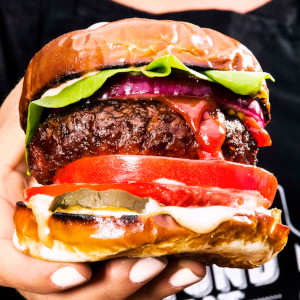
There’s no question that the stereotypical image of the ‘meat eater’ is male. Think: cave men gnawing on bones, cattle-drive trail hands, intrepid deer hunters, ‘BBQ masters’… Meat substitute makers must consider the ‘macho factor’…
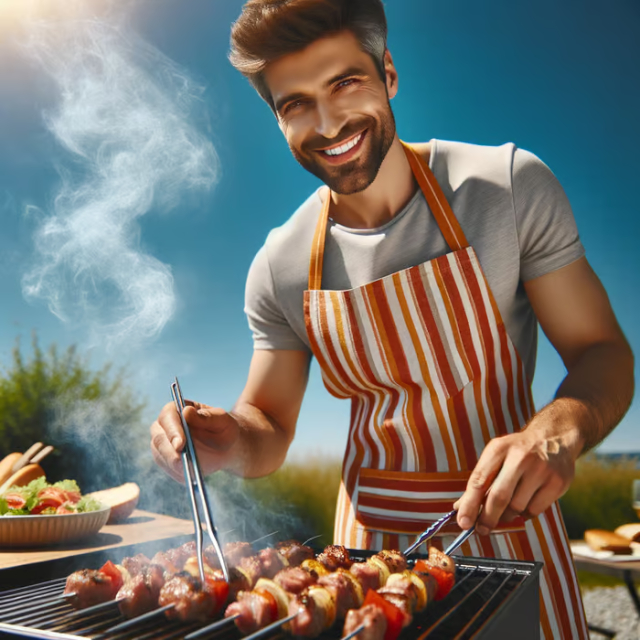 An AI-idealized portrait of the ‘2000s BBQ Master’. No longer so heavily-muscled or bronzed
as his hunter forebears, but now the stereotype of the classic male meat eater…
Even from earliest, prehistoric times, meat was identified as a male responsibility, and the veggies (such as they were) have been within the female realm. Witness the popular anthropological term ‘hunter-gatherers’. The hunters assumed to be men and the gatherers, women.
More recently…
Deer hunting is unquestionably a classic American pastime, which has survived to this day. The early pioneers relied on venison to survive. The men caught it, and the women cooked it. Even in indi-genous communities, that division of duties was maintained.
History books tell us there were many famous, capable women on the American Frontier. But few if any on the cattle drives that brought meat on the hoof from wild-west ranches to the ‘rail heads’ – the ends of the lines before the railroads extended all the way across the continent. Even to cook for the hands.
The (now infamous) Marlboro Man might just as easily have been gnawing on a tomahawk steak as smoking a cigarette.
The British pheasant shoot, which reached its peak of popularity during post-Victorian times, was traditionally the preserve of men. It was a testosterone-infused ‘entertainment’ for rich, influential men, an opportunity to assert their manliness.
At least, they fetched their cull back to the manner house to be cleaned and eaten. Preparation being a low-level female job usually performed by women, often under the supervision of male chefs.
Contemporary misogyny
Perhaps the foremost advocates of the manliness of meat in the post-WW II area have been the so-called ‘outdoorsmen’s’ mags, lead in their misogynistic march by the likes of Field & Stream, Sports Afield, and Gun Digest. But mainstream ‘men’s’ mags have also made a big, messy impact on meat culture.
As Food & Wine recounts, “[T]he 1949 Esquire’s Handbook for Hosts opens with the assertion that, “The world’s greatest cooks are men. Since the beginning of time, he-men have always prepared the savory dishes that caress the palates of epicures of every nation.”
“The handbook goes on to slam ‘woman’s magazine salads’ and ‘doily tearoom fare’, making a curious claim that, ‘women don’t seem to understand fish’ and declaring that a game-based stew is ‘second only to steak in its standing as a Man’s Dish’.”
“Sixty two years later, Esquire’s Eat Like a Man: The Only Cookbook a Man Will Ever Need (based on the mag’s column of the same name) may have dropped […] the aggressively misogynistic rhetoric, but still, the front cover boasts an obligatory black-and-blue bone-in steak, and the back [pages], a list of 15 male contributing chefs.”
And it’s important to note that Eat Like A Man still boasts a reader rating of 4.5/5.0 stars on Amazon.
Now, it’s BBQ culture…
Hunting culture has most recently given way to BBQ culture as the bastion of male meat mythology. The rifle has been replaced by the spatula. But the guy in the picture is still portrayed as manly and confident – if no longer so heavily muscled or bronzed.
And one of the foremost veg-first meat substitute pioneers, Ross MacKay, says his Daring Foods brand is still having a tough time tenderizing the American male demographic to his products.
He grew up in Glasgow, Scotland, where, “We made our legacy on Scotch beef and salmon and whisky, and black pudding is a tradition,” Mackay told Food & Wine. “There, I lived in a world where ‘real’ men eat meat.”
But, when he went away to university, he discovered a bigger, wider world of food, Including vegetables. And when he tried a vegetarian eating regimen, he found he felt better and had more energy.
Alas, he recalls, “I was the only one of my friends, and I was the only one in my school, and I was the only one at my college.”
Macro vs. micro
MacKay says he’s figured out how to market his products more successfully to the macho set. While more-entrenched plant-based meat makers such as Beyond Foods and Impossible Foods have concentrated on marketing their products as good for you at the micro (vitamins, minerals and nutrients) level, MacKay says he’s showcasing the other extreme. He’s promoting his sophisticated, look-alike chicken products as high in protein and the ‘macro’ characteristics men want. And sales stats show the gap is closing between his male and female fans.
“Women may be more concerned with other aspects, but men have been concerned with the high protein, low fat, macro base.” MacKay explains. “In messaging that, we’ve been able to win over the male audience. Our consumer right now is still skewed female/male, but it’s extremely close, about 55/45.”
My take
If MacKay’s marketing model is as successful in winning-over male consumers as he says it is… Struggling Beyond and Impossible, and their ilk could do well to follow MacKay’s example. It might just get the whole plant-based meat industry out of the potentially-deadly doldrums in which it currently finds itself…
~ Maggie J.