

‘Chocflation’. That’s what some melodramatic journalists have dubbed the historic increase in choc-olate prices over the past few years. But chocolate giants such as Lindt and Hershey are actively exploring alternatives to the climate-sensitive cocoa bean…
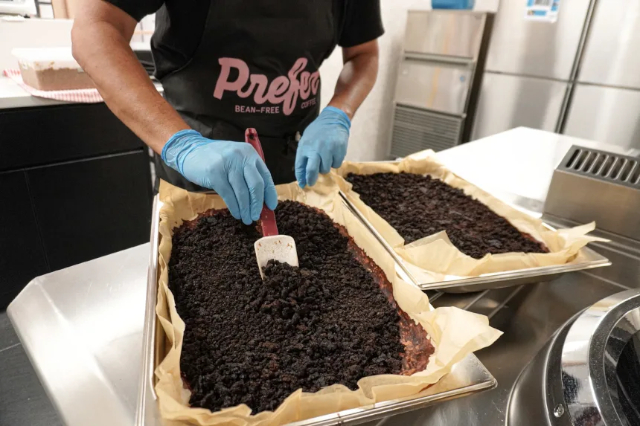 A test batch of PreferChoc Dark Cocoa alterative in the Prefer Labs…
Not unprecedented
Using alternative sources to produce ‘that Chocolate Taste’ may not be as crazy as it sounds. It’s certainly possible. In fact, several companies are ready to supply ‘chocolate’ from carob, oats, sun-flower seeds, and fava beans.
Startups like Planet A Foods (ChoViva), Voyage Foods, and Foreverland use fermentation and roasting to replicate chocolate’s texture and taste, while confectionary giants including Barry Callebaut and Cargill partner to scale these sustainable alternatives for mass production.
‘Alt-Coffee’ already on the market
One Singapore-based startup already has its Alt-Coffee products in stores in Singapore, Vietnam, and the Philippines. And that, Prefer foods co-founder Jake Berber says, clearly demonstrates the potent-ial for ‘alternatives’. “We’re able to help even the largest coffee businesses in the world reduce their cost of coffee by about 50 percent.”
“Receptivity has actually been quite strong […] especially from mass-market consumers where price is extremely important to them,” Berber insists. He claims that for, “anywhere between [a] 30 and 50 percent inclusion rate,” of PreferChoc in hybrid chocolate products, “there is no change in flavour.”
How so they do it?
“Very simply, we are able to create cocoa flavours and ingredients without the cocoa beans,” says Jake Berber, who co-founded the food-tech company in 2022.
PreferChoc ferments and roasts cheap, plentiful seeds and grains. The product can then be used in almost all cocoa applications, from drinking chocolate to baking and confectionery.
Pros and cons…
The positive aspects of using Alt-Cocoa products are huge. A 50 percent decrease in the amount of real cocoa in every day ‘chocolate’ products means prices could drop even more steeply than they rose during the price crisis. And sustainability advocates point out that cocoa needs a lot of water and space to grow. Alt-Cocoa products could cut that environmental impact substantially.
But the negative aspects of an Alt-Cocoa revolution are also major. For African countries such as the Ivory Coast and Ghana, where cocoa production is the largest contributor to the export economy, a 50 percent drop in cocoa sales would mean a drastic reduction in revenues and jobs.
My take
It appears that, if we’re to have ‘chocolate’ in the future, it will almost certainly consist of Alt-Cocoa products. If we insist on real cocoa, very few of us will be able to afford it.
And, if West African cocoa producers continue to cut down their forests at the present rate – to establish new cocoa plantations – the world will be significantly worse off environmentally.
“We use staples of our food system,” Berber says; “ingredients … that really are scalable. And [using them] wouldn’t move the needle on [their] price or availability.”
Bravo, PreferChoc! But I want to taste the stuff first, to be sure I’m betting on the right horse…
~ Maggie J.