

It’s been pointed out to me that there are now several plant-based egg substitutes – primarily liquids equivalent to beaten eggs. Could these be of service to you in surviving the current fresh-egg short-age and price hikes?
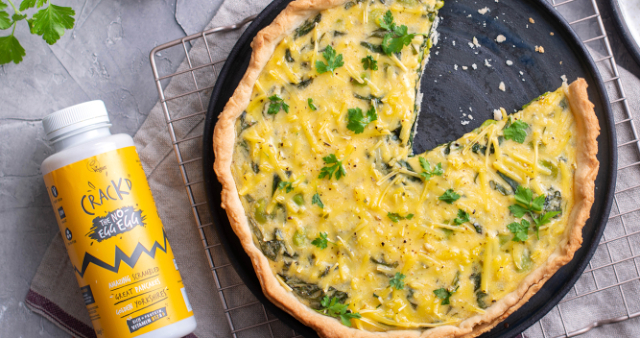 Crack’d – ‘The No-Egg Egg’ is already a fave in the UK. Here in North America there’s
also a Just-brand liquid plant-based substitute. The only issues are, these small
start-ups couldn’t fill a continent-wide mass demand mass demand.
And they’re both already more expensive than real eggs…
Not a new idea
One legend of army life used to be the universal dread of powdered eggs – which were the only kind you’d get on deployment and often in camp.
The skill of the mess cooks making your breakfast would determine whether these ‘eggs’, when re-constituted, showed some reasonable resemblance to real scrambled eggs, or – more often – a watery, gummy, or otherwise disastrous mess. But at least, they started out as real eggs.
You’ll still find powdered eggs among those free-dried survival rations they’re selling in big, bunker-ready kits, and as onesies and twosies for hikers and hunters.
The modern equivalent
I’ve been aware since culinary school that many chefs – and virtually all food processors – routinely use various commercial substances as substitutes for real eggs. They’re either powders or fluids with roughly the same colour and texture – if not the nutritional value.
The big factory-based brands love these products because they make it possible to avoid the chore of cracking all those eggs – either by machine or by hand. And then filtering or otherwise ‘treating’ them to remove shell fragments and other debris that may have adhered to the outside of the shells…
Consistent fluid or powdered consistency is also helpful in maintaining consistency in their manu-facturing processes and, thus, in the resulting products.
Like liquid real eggs, these commercial egg substitutes also have longer shelf lives than fresh eggs – another obvious advantage to manufacturers.
Now, there’s another option
As I mentioned… The plant-based substitutes sector has recently glommed onto the market for egg substitutes as an entrée to the wider world of plant based foods.
Their approach is generally a fluid-format product, fortified with all the good stuff that real eggs offer but plant substitutes don’t. Largely, essential nutrients.
But they’ve made some real advances in product taste, texture and colour. Making their substitutes more acceptable as direct replacements for real eggs.
One big caveat…
The new plant-based egg substitutes – though more cosmetically and nutritionally acceptable to consumers than their predecessors – continue to be significantly more expensive than real eggs. And not nearly as easy to find – under normal circumstances.
My take
I’d use – or at least try once – any of the new plant-based egg substitutes in baking or other cooking applications. And I’d be glad to have them available, if there was no other option, to create an occasional panful of would-be scrambled eggs or a faux omelet. Or even a quiche.
But I’m afraid I’m too old-school to consider the new replacements as day-to-day substitutes for real eggs…
~ Maggie J.