

I hope you were as shocked as I was to read the headline. We assume that supermarket baby foods sold at reputable stores are safe, nutritious and healthy. But a new study reveals that a ‘majority’ of baby foods fail to meet nutritional standards…
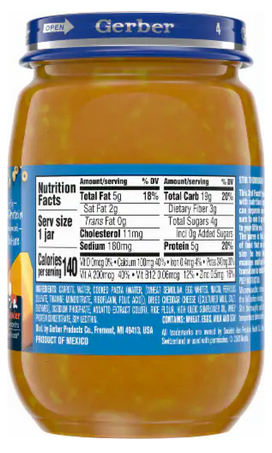 The study, from The George Institute for Global Health, is published in Nutrients, an international peer-reviewed journal. And it sends up a warning flare for the millions of young families that rely on jarred baby foods give their little ones the start in life they need.
What they did
It was a simple exercise in theory, but took some hard work to accomplish. The research surveyed 651 different food products across ten major US supermarkets, including Walmart, Target, Kroger, Costco, and Aldi. All samples were subjected the same range of chemical analyses and other lab tests.
What they found
The study report lays it on the line: “[Researchers] ulti-mately [found] not only that 60 percent failed to meet the nutritional stipulations outlined by the WHO’s nutrient and promotion profile model (NPPM), but that none of them met the NPPM’s requirements for promotions — meaning certain items may have misleading marketing claims on them, giving the impression that they’re healthier than they actually are.”
So… The sad truth is, many manufacturers not only sell sub-standard products, but lie about them in their advertising.
Nutrition is critical
Proper nutrition is critical early in life, especially in infancy, when children are growing and devel-oping at a furious rate (compared to later in life), both in body and mind.
A previous study found that: “Maternal nutrition needs to be addressed during pregnancy for the child’s first 1,000 days of life, or roughly between conception and a child’s second birthday. The infant requires just breast milk for the first six months of life.”
That study’s abstract goes on to explain: “There is a strong link between nutrition, well-being, and learning. The nutritional intake of infants, children, and adolescents maintains the body weight and [must be] sufficient to sustain their normal growth and development. […] Rapid growth occurs during infancy. Compared to other growth phases, this phase has the largest relative energy and food needs for body size.”
Findings focus on sugars, inadequacies
Key study findings include:
- Sweet purées and snack foods dominate the market.
- These derive a high proportion of energy from free sugar (including fruit juice) or because intense maceration (puréeing) has released intrinsic sugars from within plant cell walls.
- Many products do not adhere to WHO’s recommendation to introduce food at 6 months and are marketed as suitable from 4 months, potentially displacing breast milk.
- Over 70 percent of products failed to meet minimum protein requirements.
- Many also contained higher-than-recommended levels of salt.
- Packaged snacks and convenience foods were ‘particularly culpable’.
- NONE of the products tested met the NPPM’s requirements for promotions — meaning certain items may have misleading marketing claims on [their labels], giving the impression that they’re healthier than they actually are.
And…
- Previous studies have noted that, just because a product is labelled ‘natural’ or organic’, that doesn’t necessarily mean it’s nutritionally better for your child. Read the ingredients list!
The takeaway
The study team hastens to assure parents that, just because a specific infant food item does not met the NPPM standards doesn’t mean it will harm their child.
Registered Dietitian and pediatric nutrition expert Lauren Manaker points out that: “What is more important is looking at the overall diet of the infant and ensuring that they are meeting their nutritional needs from a wide variety of foods.
“With the concerns highlighted in this report, it emphasizes the importance of parents not relying on claims on food packages to help them navigate their food choices.”
My take
Baby food manufacturers must be brought to heel over the inadequacies of their products and their inflatio9nary claims for them.
But the underlying problem this new study reveals is that many parents may be blissfully unaware that many commercially prepared baby foods are not meeting their children’s nutritional needs.
And in the end, regardless of external factors, it’s up to parents to make sure that their kids are being fed properly.
~ Maggie J.