
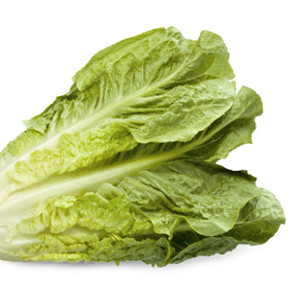
Consider the frequency of lettuce and other salad green recalls over the past decade. And it comes as no surprise that this vast and varied produce category has surfaced as the primary cause of food borne illness in North America….
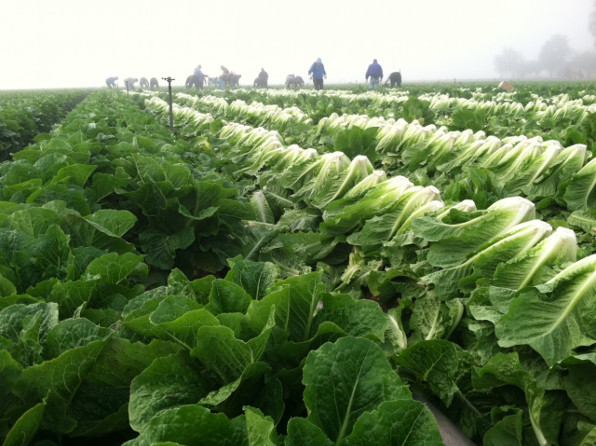 A mile-long field of Romaine Lettuce in mid-harvest in California’s lush
Central Valley. These lettuces will be shipped all over North America.
There’s no member of the produce world that gets more bad press than the Salad Kingdom. I always have Romaine Lettuce in he house, and often add spinach or kale, depending on my mood. And I pay particular attention to any recall alerts. So, it’s no surprise to me that the latest study on food borne disease spotlights greens as a central issue…
What they did
Researchers at Ohio State University conducted a study on the social burden and economic costs of foodborne illnesses associated specifically with leafy greens, in the United States.
The team, led by Dr. Xuerui Yang and Dr. Robert Scharff, analysed data generated during three major ‘food poisoning’ outbreaks. And they discovered it’s a huge problem.
What they found
The team boiled down its key findings as follows:
- The leafy greens illness attribution rate is highest for Shiga toxin-producing E. coli.
- Norovirus, STEC, Campylobacter have the highest rate of leafy green illnesses and costs.
- Lettuces are linked to over 75.7 percent of leafy green food borne illnesses and 70 percent of costs.
- Up to 9.2 percent of known pathogen-caused food borne illnesses can be attributed to leafy greens.
- Leafy greens are tied to 2,307,558 estimated illnesses and $5.28 billion in costs annually.
And, again, it’s no surprise that romaine lettuce is particularly significant, with nearly 20 percent of Shiga toxin-producing E.coli illnesses linked to romaine consumption. This translates to an estimated 12,496 illnesses and $324.64 million in costs annually.
The takeaway
‘The study underscores the importance of addressing food safety issues related to leafy greens, given their widespread consumption and significant contribution to foodborne illnesses and economic burdens,” Food Safety News says. “It also highlights the need for targeted interventions and regulatory measures to mitigate the risks associated with leafy green consumption.
My take
There are some important things we can all do to protect ourselves and out families from food borne illnesses carried by leafy greens.
- During any outbreak, always check to see leafy greens already in your fridge are not from a growing area identified as contaminated .
- Wash all your greens thoroughly. Although, some E.coli infections are drawn inside the plant as it absorbs contaminated ground water. Heed all public health warnings.
- Buy your greens in small quantities to reduce the risk of financial loss if you have to return or toss any.
And avoid pre-cut greens or ‘salad mixes’. They’re just naturally more susceptible to contamination or early spoilage than whole, uncut veggies….
~ Maggie J.