
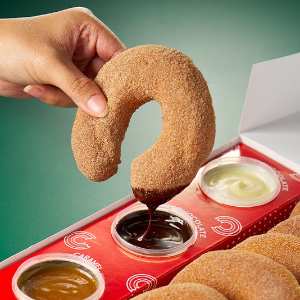
Why did Krispy Kreme bring a Churro doughnut all the way to the Philippines? And why isn’t this idea already in play in the US, where Mexican food is almost an official cuisine? And why is this Churro doughnut neither a proper ring nor filled?
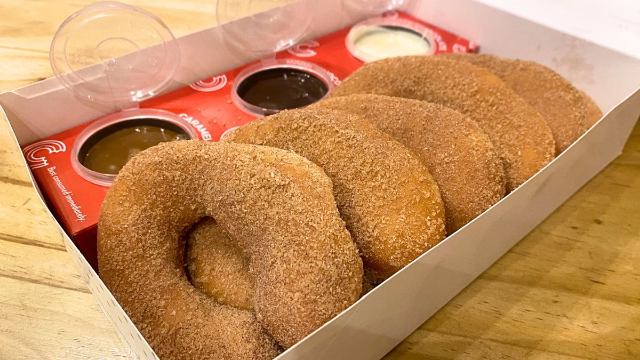
I have been moved, several times recently, to spotlight food sector promos and new products that represent the industry’s best and brightest creative instincts. Today, I have to do the reverse.
Why? Why? Why?
Normally, I would have saved this oddity for the Novelties section of Fast Food Week. But I had so many questions, I felt it deserved its own separate post.
Why premier a Mexican dessert in the Philippines? Why a doughnut and not a real churro? Why a herradura (‘horseshoe’ in Spanish), rather than a classic ‘ring’ or ‘filled’ form factor? And most com-pellingly, why not début this potentially nifty treat in the US, where it would, logically, be most likely to attract a large fan base??
What it is
Reporters on the spot say the Churro Doughnut is much like the classic Krispy Kreme (KK) Original Glazed sinker in texture. But that’s where the similarity ends. It’s not just broken ring, but a true horseshoe. And it’s not glazed, but dusted with a cinnamon-sugar blend – the classic finish for a real churro.
The differences extend to the packaging, which features a multi-piece array of the product plus three special dips: Caramel, Chocolate and White Chocolate. They come in slightly-larger than normal tubs, perfect for dipping the chubby snacks.
Dipping design a plus
 One big plus – which I gasped at – was the open-ring horseshoe design. The Churro Doughnut is brilliantly conceived for dipping. Which is something folks have done with sinkers since doughnuts and coffee were first ordered together.
But… Traditionally-shaped doughnuts have always been inconvenient to dip – whether in coffee or a sauce. Because most mugs and cups are too narrow-mouthed to accommodate them before you take your fist bite, creating an accessible tip.
An effort was made, decades ago, to get around this problem. It’s immortalized on the classic Maxwell House coffee label. Note, in the reproduction (above, left) the broad, shallow coffee cup, designed for dunking classic doughnuts. It’s still a fixture at some retro and ‘classic’ diners and doughnut shops. But not the ‘standard’ it once was.
Why the Phillipines?
KK doesn’t say, specifically. But I discovered, during further research, that churros are not beloved only in Mexico and across Latin America. They are, in fact, a fixture in Filipino cuisine.
Alongside SPAM, Asian delicacies and other dishes that were brought to the Nation of 7,641 Islands by traders, tourists, immigrants fleeing oppressive Asian regimes, and even US soldiers (during WW II).
My take
The remaining questions I posed at the outset of this post can be addressed as ‘so obvious, I looked right past them’.
First, the thing is a Churro Doughnut, rather than a Churro, proper, because ‘doughnuts’ is what KK does. In reflection, it’s natural that product the KK test kitchen brain trust dreams up will be a dough-nut first, and whatever it pays homage to, second.
And, on a practical plane, KK is massively invested in doughnut-making machinery. It would cost millions to add to or adapt their system make real churros. And imagine the hassle of coming up with a proper churro dough recipe different from their regular doughnut formula.
All that said… Why didn’t someone come up with this brilliant invention to facilitate dunking doughnuts in coffee long before now?
Nevertheless… My original question remains unanswered: Why didn’t KK introduce this fascinating, yet somehow frustrating, new concept in North America first?
~ Maggie J.