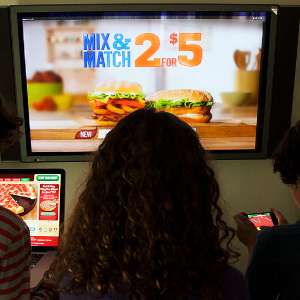
It’s easy to blame junk food marketing for making children overweight. After all, the statistics are there, showing just how influential these ads can be on young minds. However, it’s not just the marketing that’s at fault here…

… It’s a byproduct of a lack of appropriate legislation, health education, and public awareness of the problem.
What are the Leaders Doing?
Unfortunately, few countries take steps to tackle the underlying causes of childhood obesity, like regulating junk food marketing or making healthy options affordable. This doesn’t mean govern-ments aren’t trying – but they could be doing a lot more than they are.
Tackling Obesity in the United States
The obesity epidemic in the US is prevalent, but it doesn’t seem to concern as many people as it should. Despite calls for action from many directions over the years, the government has yet to take major steps toward tackling child obesity and overconsumption in general. The there are no country-wide bans or restrictions on marketing junk food to children, and it doesn’t do much when it comes to promoting healthy lifestyles.
Michelle Obama tried to encourage better nutrition and promote physical activity among children with her Let’s Move program, launched back in 2010. Unfortunately, the move was doomed from the start as it didn’t receive extensive funding, despite being led by the First Lady. It also lacked know-ledgeable specialists who could help shape the program into a successful campaign.
Some people also decided to boycott the Let’s Move initiative simply because it was led by Michelle Obama herself. The program received mixed responses from the start, almost pre-deciding its suc-cess – or lack thereof. Despite the goal to decrease childhood obesity by 5% by 2030, the campaign is yet to see any results.
Some US states implemented sugar tax within their borders, but it’s not a federal-level legislation. These taxes have had varying degrees of success. In some cities, such as Boulder, Philadelphia, Oak-land, San Francisco, and Seattle, the introduction of sugar taxes reduced purchases of sugary bever-ages by as much as 33%. However, the impact of these taxes on overall public health is still a matter of study and debate.
The lack of legislation around junk food marketing and distribution means some residents are tack-ling obesity with medication. In 2023, we saw huge shortages of Ozempic, a drug used for diabetes with a slimming side effect, but it’s only one of many drugs overweight patients tend to reach for. If not regulated, this could create an issue of potential medication misuse and addiction.
Legislative Moves against Obesity in the United Kingdom
The UK takes a more proactive approach to tackling childhood obesity. The government introduced a series of new measures to restrict junk food access over the past decade, alongside many celebrities campaigning for healthier lifestyles among children. The most important changes include restricting unhealthy foods displayed by the tills, mandatory calorie labels on restaurant menus, and a traffic-light labelling system on all products.
Additionally, the UK government introduced a tax on sugary drinks in 2018. The new law means that any producer or importer of a sugary drink must pay a levy to offset the damages. The levy doesn’t apply to drinks with less than 5g of sugar per 100 ml, but it can go up to 24p per liter on soft drinks that contain more than 8g of sugar per 100 ml. So far, it has been a huge success, as the total sugar sold in soft drinks by retailers and manufacturers decreased by 35.4% between 2015 and 2019.
When promoting healthy lifestyles at schools, the UK government has also been making improve-ments, largely due to Jamie Oliver’s nutritional campaigns. So far, schools have had to remove junk food vending machines, start offering nutrition classes to pupils, and adhere to new school meal guidance. These include swapping sugary drinks for healthy alternatives, limiting fried food to twice per week, and offering a variety of vegetables with every meal.
 In 2016, Jamie Oliver launched an ongoing world-wide campaign to ensure
that all children get enough healthy food, not just to survive, but thrive…
Sadly, the nutritional regulations are rarely enforced by the government or local authorities. This means schools’ compliance varies heavily and depends on various factors, like budget and funding, which are often lacking.
More recently, the UK government announced a plan to ban junk food ads online and on TV before 9 p.m. This would be a monumental move and a first step towards restricting junk food marketing reach. However, the bill has been postponed multiple times, with the current implementation date still to be announced.
The proposed legislation keeps undergoing new revisions, which severely changed it since it was first announced. Its current form allows brand-only ads, which creates a loophole for junk food compan-ies to play promotions before 9 p.m. as long as they don’t show any food. If a junk food brand has a website or a social media account, they’d be free to market their products there regardless of the time. Smaller businesses would also be exempt from the restriction, as would billboard, radio, and poster advertising.
Junk Food Marketing Regulations in the European Union
Just like the US and the UK, the EU relies on companies to self-regulate when it comes to junk food marketing. However, the union encouraged member states to follow its action plan to tackle child-ren’s obesity in 2014–2020. The proposed guidelines included addressing unhealthy eating patterns, physical activity patterns, sedentary lifestyles, and parental socioeconomic status.
Many EU member states also tackle their childhood obesity issue with their legislation. This differs depending on which country you’re looking at as some prioritize promoting healthy lifestyles more than others.
France has one of the most successful programs, EPODE, which translates to “Together Let’s Prevent Childhood Obesity.” It looks at every aspect of a child’s life to identify the root causes of obesity. It also involves everyone in the child’s life when it comes to implementing changes, including parents, schools, doctors, communities, and even businesses. The program is credited with being one of the main reasons why France has some of the lowest child obesity rates in Europe.
Additionally, the French government banned fizzy drinks and snack vending machines in schools, as well as misleading TV and print advertising. It imposed a 1.5% tax on junk food companies that don’t promote healthy eating. More recently, the country also decided to roll out a new treatment program for children who are already overweight. It will include drafting a special diet, physical activity plan, and psychological counselling.
The German government often faces backlash from the country’s residents and corporations when-ever it tries to implement strict restrictions on junk food and obesity. Because of this, current legis-lation on the topic is quite vague. The country has some dietary and physical activity guidelines for children and teens, informative food nutrition labels on products, and lenient restrictions on junk food advertising. These are still only voluntary, though.
Finally, Spain recently introduced a new plan which aims to reduce childhood obesity in the country by 25% by 2030. The plan will follow found pillars of healthy living habits, such as physical activity, healthy eating, sleep, and emotional well-being. As part of that plan, the country is looking to intro-duce an advertising ban to stop the promotion of unhealthy foods and drinks.
Tomorrow: How to Protect Your Children…
***
Are you enjoying this new series on Junk Food Advertising targeted to kids? It’s a first here on the Fab Food Blog. Let us know what you think. If our faithful readers approve, we’ll bring you more such in-depth reports in the future! ~ Maggie J.
***
This is Part VII of a new series – a first for the Fab Food Blog – produced by The Digital Dinner Table, which is solely responsible for all content and opinions expressed.
For information, contact:
Michael Cooper
Digital Literacy & Youth Health Advocate