
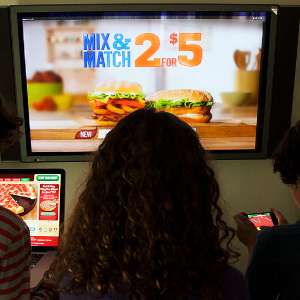
Aside from social media marketing, junk food brands often utilize other forms of internet content to advertise their products. Gaming platforms are often the main focus, with some companies creating their own branded mini-games. These are usually simple, such as creating a sundae or shooting burgers out of a cannon. However, they generate higher engagement and create memorable exper-iences children are likely to recall later on.
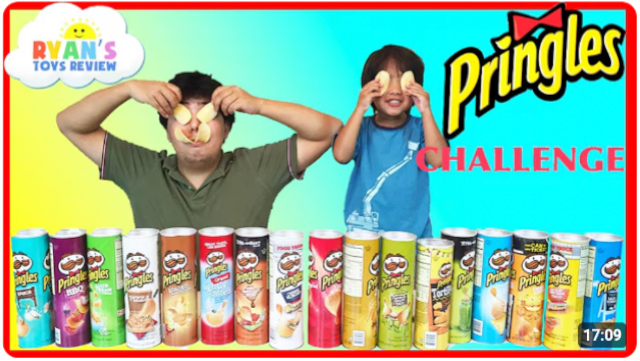 A Pringles In-Content Ad/Game: On Ryan’s World – A Kids’-targeted YouTube channel.
Online Junk Food Marketing
Even without branded games, children often see banner advertising on the sides, top, and bottom of websites, like gaming platforms or blogs. It’s a clever way to blend marketing with entertainment, making it harder for kids (and sometimes parents) to recognize it as advertising.
During the pandemic, some big food companies also started advertising on learning platforms. This caused quite a stir. Health experts and even some schools expressed their concerns and lack of ap-proval about unhealthy snacks mixing with education. Not only is it distracting, but it encourages children to think about junk food when they may not be even hungry.
Some of these offer the option to subscribe for a fee to eliminate ads. But some families can’t afford to pay to get rid of these ads. Others refuse to pay on general principles. Which means some kids get more of this ad bombardment than others.
The good news is, after many people raised their concerns, junk food companies agreed to stop ad-vertising on learning platforms. It’s a step towards keeping online learning spaces just for studying, without tempting ads for junk food. But it’s a heads-up for all of us to keep an eye on where advert-isements are popping up, especially in places where kids should be able to learn and play online.
Junk Food Marketing and Digital Safety Concerns
Junk food marketing in the digital space, particularly on platforms frequented by children, brings digital safety concerns into focus. For example, children might be exposed to targeted advertising on educational websites or apps, where they’re more vulnerable to persuasive marketing tactics. This exposure raises concerns about children’s online privacy and the potential for manipulative advert-ising practices.
Parental controls on sites such as YouTube and Facebook, or in the browsers your kids use, or a Virtual Private Network can help you limit your kids’ exposure to online advertising. A VPN free trial lets you experience firsthand how anonymizing your internet connection and location can limit targeted advertising. This can help you ensure your children will be less likely to encounter person-alized junk food ads based on their online behaviour or location, offering an extra layer of digital safety.
Tomorrow:
***
Are you enjoying this new series on Junk Food Advertising targeted to kids? It’s a first here on the Fab Food Blog. Let us know what you think. If our faithful readers approve, we’ll bring you more such in-depth reports in the future! ~ Maggie J.
***
This is Part IV of a new series – a first for the Fab Food Blog – produced by The Digital Dinner Table, which is solely responsible for all content and opinions expressed.
For information, contact:
Michael Cooper
Digital Literacy & Youth Health Advocate