
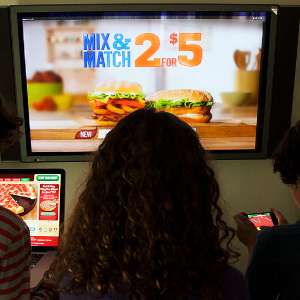
Almost 5 billion people use social media daily, so it’s not surprising that junk food marketing has spread across popular platforms. According to a study, young people see various junk food marketing on social media anywhere between 30–189 times per week. A majority of these ads contained promo-tions for high-sugar products and fast foods.

Social Media strategies
Experts agree junk food marketing on social media is much more worrying than regular advertising because it helps brands build a two-way form of communication with children. Companies now act-ively involve younger audiences in their campaigns using competitions and giveaways. Examples include asking children to upload a selfie with their favorite junk food in hopes of winning a yearly supply of that product.
Influencers worrisome
Influencer marketing is also becoming more used across social media, making junk food promotions even more worrisome. Though you can find an occasional influ-encer with a background in nutrition, they rarely agree to promote junk food. This means any fast food or snack promotions you see online come from people who don’t fully understand what they’re promoting or how it could affect their audience.
Many studies show just how influential these promotions are. In 2017, around 42% of branded influ-encer videos promoted candy, while another 32% included sweet/salty snacks, sugary drinks, and ice cream. As a result, children and teens who were exposed to these advertising videos, consumed around 26% more calories than those who didn’t watch the same content.
This trend is particularly visible on YouTube. According to the American Academy of Pediatrics, 90% of food promotions on YouTube are for types of junk food. Just a quick search on the platform reveals hundreds of videos of kids unboxing new Happy Meal toys, reviewing new Hershey’s chocolates, and receiving PR packages from big junk food brands. And since influencers often feel like a ‘friend’ to viewers, they’re more likely to convince them to make a purchase and bring profit to the advertised company.
It’s becoming a huge concern for parents, but it’s almost impossible to regulate. YouTube banned food ads popping up during videos for kids in 2020, but it couldn’t stop in-video promotions. Influ-encers also don’t always voluntarily disclose collaborations with junk food brands, making it difficult to pinpoint what’s an ad and what’s regular content. And even if the government decided to put stricter regulations in place, influencer marketing isn’t always subject to them.
YouTube the biggest channel
We decided to check what YouTube marketing looks like for ourselves. We watched over 78 hours of YouTube videos aimed at kids in the US, France, Germany, and Spain, which worked out to 37 videos for each country. Our research confirmed that the video platform doesn’t show junk food ads to children – but it does allow other, sometimes concerning promotions.
According to our findings, children in all countries we checked are mostly exposed to adult market-ing. A majority of ads we came across were for car dealerships, laptops, insurance offers, and holi-days. YouTube Spain and Germany seemed to promote new games on various platforms, including Nintendo Switch and PC, many of which promoted content that was unsuitable for viewers as young as the videos we viewed were intended for. Occasionally, we stumbled upon an ad for another child-friendly YouTube channel, but it rarely seemed connected to the topic our current video was about. These videos sometimes included product placement of toys or games. We also came across ads for products like Disney+ subscriptions.
Good news, bad news
These results can be interpreted as both good and bad. It’s good that children won’t be exposed to more junk food ads than they already are, but exposing young viewers to any form of marketing isn’t ideal. Studies show it very often creates untrue biases in developing minds, which they take with them into adulthood. These perceptions are often very difficult to change, forcing a specific outlook on certain parts of life. The proliferation of gaming ads is also worrying, given the research showing the addictive nature of gaming and its impacts.
Advertising also aims to evoke emotions in its viewers. As an adult, these can be easy to understand and handle, but children often have a harder time doing so. Since they can take situations in ads very literally, they may get scared, hurt, or even traumatized. They could potentially be encouraged to perform dangerous stunts, too, depending on what they watched.
Tomorrow: Online Marketing Opportunities…
***
Are you enjoying this new series on Junk Food Advertising targeted to kids? It’s a first here on the Fab Food Blog. Let us know what you think. If our faithful readers approve, we’ll bring you more such in-depth reports in the future! ~ Maggie J.
***
This is Part III of a new series – a first for the Fab Food Blog – produced by The Digital Dinner Table, which is solely responsible for all content and opinions expressed.
For information, contact:
Michael Cooper
Digital Literacy & Youth Health Advocate