
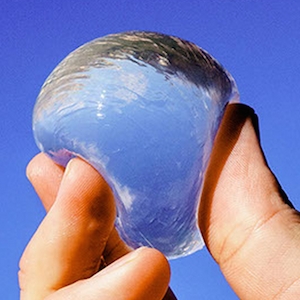
It seems like a hazy proposition to me… But scientists in South America say they’ve successfully condensed drinking water from mountain mists above the lofty Atacama Desert Plateau. It could be the world’s most important new fresh water source…
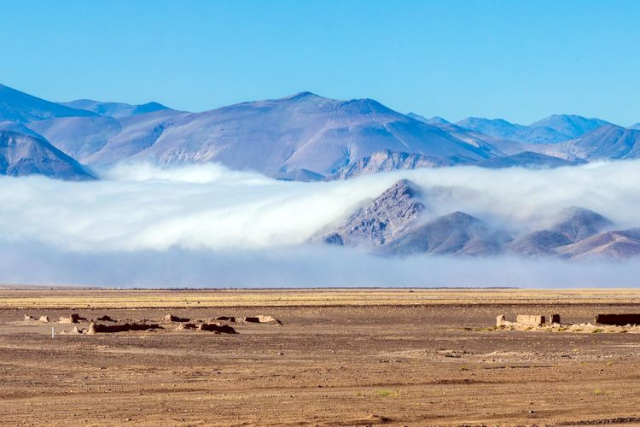 Dense fog: A regular occurrence in the mountains above the Atacama Desert Plateau…
Water is scarce on the ground on the ground in Peru’s Atacama desert. The official annual rainfall there amounts to no more than 0.2 in / 5.8 mm per year. And what water there is (including soil moisture, snow, and ice) has been declining by 0.4 in / 10.1 mm per year…
A major emergency
It’s a major emergency for those few hardy souls who live in the region. But researchers have per-fected a process they say can pull moisture out of thin – actually, thick – air.
What they did
The idea was to capture fog, which sweeps the mountains that rise above the plateau daily, using special nets hung in the wind.
According to a Food & Wine story, “the fog collectors are simply pieces of mesh suspended between two posts. The water droplets collect on the mesh and fall into a gutter system that drains into water storage tanks. This method, they added, requires ‘no extra energy’ output as a bonus.”
“The team found they could collect up to 10 litres per square meter per day, which they estimated would be enough to supplement the water supply for the community of 10,000 people for irrigation, agriculture, and human consumption.”
Could be used anywhere
The fog-harvesting system could be used anywhere on earth there are suitable mountains which produce suitable mists. It’s particularly suited to the Atacama, which is perhaps the world’s most extreme high desert region.
There, researchers were able to collect up to 10 litres of water per square meter per day. That, they claim, would be enough to ‘supplement the water supply for a community of 10,000 people for irrigation, agriculture, and human consumption’.
Some caveats
It has not yet been determined how many places there may be around the world where the fog-capture system could work. But the researchers admit, a set of ‘Goldilocks’ conditions must be in place for success.
The cost of the capturing system is relatively modest. But the cost of a storage and piping system could be huge, depending on how far the water has to travel to its end users.
I also wonder about the actual quality of the water the capture system will produce. The system is essentially making artificial rain by condensing water vapour from the air. And we’ve had some troubling warnings from health and safety experts over the past year about drinking rainwater or eating snow – even if it isn’t yellow.
The Centres for Disease Control (CDC) point out that, “Dust, smoke, and other particles in the air can contaminate rainwater before it lands on your roof. […] Dirt and germs from the roof can also wash into the rainwater you collect. For example, bird poop on your roof can end up in your rainwater barrel or tank. […] Once rainwater falls, chemicals like asbestos, lead, or copper can get into the water.”
My take
Even when I was little, my Dad warned against drinking rain water or eating snow. He worked on a farm when he was young, and knew how important it was to keep the well water separate from the pond water. Not to mention how important it was to test the well water regularly…
~ Maggie J.