
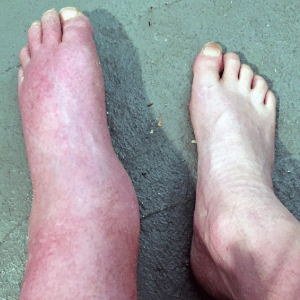
It’s rarely a problem for kids and younger adults. But swelling in the lower legs, ankles and feet can be a debilitating affliction for older folks. Fortunately, you can alleviate or avoid edema by steering clear of key food groups…
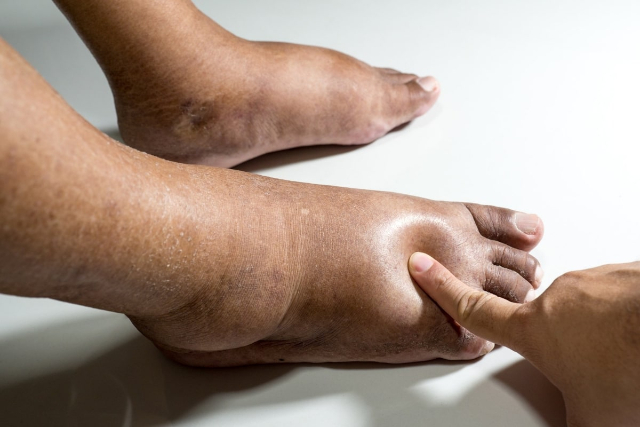
Know your enemy
I know my worst enemy better than I wish I did. It’s edema – swelling of the lower legs, ankles and feet. I also know, all too well, that it can be triggered by many common conditions. And I am acutely aware that it can be extremely painful. Even temporarily crippling.
What is it?
Edema results a simple mechanism, but it can have wide-ranging deleterious effects on the body.
The Mayo Clinic explains: “Edema occurs when tiny blood vessels in the body, also known as capillaries, leak fluid. The fluid builds up in nearby tissues. The leak leads to swelling.”
Serious consequences
Edema may be a warning sign of other serious conditions you may not be aware of until it’s too late to avoid damage. Aside from the obvious swelling , the condition may also presage:
- Congestive heart failure
- Kidney disease and damage
- Liver damage
- Weakness in the lower leg veins
- Deep Vein Thrombosis (DVT)
- Lymphatic system weakness or damage, and…
- Severe, long-term protein deficiency.
What causes edema?
Certain life circumstances and medications can trigger edema. Women, in particular, can suffer swelling in the lower limbs and feet just before their period and during pregnancy. Overweight and obese people, and folks who sit or remain in the same position for too long can also experience significant episodes of swelling.
And the following classes of medications may also make those taking them more susceptible to edema:
- High blood pressure medicines
- Nonsteroidal anti-inflammatory medicines
- Steroid medicines
- Estrogens
- Certain diabetes medicines called thiazolidinediones, and…
- Medicines use to treat nerve pain.
Eat right to fight
Disclaimer:
Yours truly has long suffered from episodes of edema. And it’s kissing cousin, gout. The latter occurs when your body has extra uric acid, and sharp crystals form in the joints. The diet-based countermeasures you can employ are the same.
What to avoid
Physicians and nutritionists agree that diet can be a powerful weapon against edema.
Essentially… You should avoid excess sugar, salt and fat. These can all cause fluids to pool in the lower extremities. Excess consumption of brad or pasta can also tri9gger swelling – especially in folks with a gluten sensitivity.
Note that the aforementioned classifications encompass a large number of specific foods and beverages. The overall classification includes all processed foods and most packaged foods.
If you still experience swelling after making some or all of the recommended dietary changes, it’s time to see your doctor, to check for the presence of any of the potentially serious ‘hidden’ conditions mentioned above. There are effective drugs that help your body purge excess fluids via the urine.
My take
I’ve suffered from occasional edema and, at one point, persistent gout since I hit my 40s. When I mentioned it to my parents and cousins, I learned that the afflictions were common on both sides of my family. And nobody bothered to warn me! Mom confided, they all just took it for granted that I’d find out on my own, and there was no sense telling me what to expect because I’d just languish in fear and dread until the inevitable came to pass. Thanks, Mom…
But I can also attest that careful, mindful eating can go a long way to alleviating the twin curses of edema and gout. I can also confirm that the medications available to fight edema and gout are highly effective.
The bottom line is, there’s no need to suffer…
~ Maggie J.