
The big news from the latest official monthly inflation report is that food prices have actually dropped. Just a little – 0.3 percent. But it’s a start. However, the mainstream and online media still seem preoccupied with the ‘high food prices’ story…
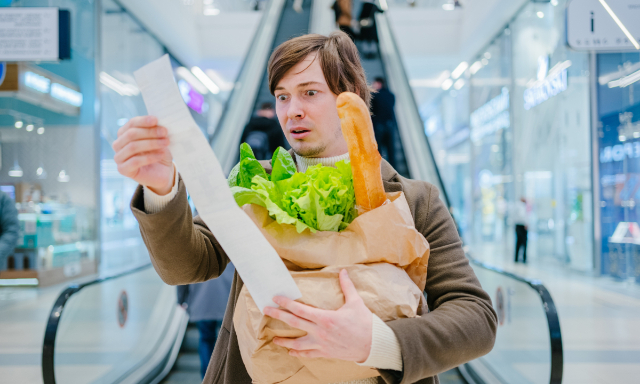 The look of surprise on this shopper’s face could have been triggered by the realization that
food prices actually dropped last month, for the first time since before the COVID Crisis!
It’s true. And I hadn’t heard anything about this possibly pivotal development. Until I came across the latest op-ed essay on the issue by Canada’s Food Guy, Dr. Sylvain Charlebois. Loyal readers will know that the good doctor is the Director of Canada’s Agrifood Analytics Lab at Dalhousie university. His team prepares dozens of food economy analyses every year, not the least of which is the annual Canada’s Food Price Report.
The pertinent facts
As we all know, from the mainstream media, food price inflation has been creeping down since the beginning of this year. The message, in a nutshell, has been that consumer prices have been stabilizing. But Charlebois wants us all to know that food price inflation has dropped below the overall rate, at just 1.4 percent last month compared to 2.3 percent.
“Statistics Canada reported this week that food inflation in April stood at 1.4 percent, indicating that food prices in stores are 1.4 percent higher than they were a year ago. However, Statistics Canada also confirmed a trend our lab has been tracking for some time: Food prices in April declined by 0.3 percent. Indeed, they dropped.”
Did you pick up, anywhere, that food prices had actually dropped, for first time in years?
Charlebois’ lament
What irks Charlebois is, the mainstream and online media both seem to have chosen to ‘remain fixated’ on the ‘high food prices’ story line. Rather than headlining the price drop.
“Not a single media outlet reported on this development. This omission is quite revealing, suggesting a pervasive preoccupation with highlighting negative news in the data,” Charlebois complains. “The data released this [past] week was certainly reassuring for the outlook for the rest of the year. Nevertheless, it appears no one paid heed, not one bit.”
A journalist’s perspective
As hard-bitten old journalist, myself, with more than 45 years experience in the business, I can understand why the major media treated the news of a food price decline the way they did. I’m not defending them. Just proposing an explanation…
First of all, trying to change the direction of, or put a new lede on a continuing story like food prices is like trying to turn an ocean liner. ‘Big’ stories carry considerable editorial and reader-perception momentum.
Second, Charlebois is right that journalists and editors tend to focus on the bigger numbers and wider spreads in any statistically-oriented story. There’s an old, entrenched mentality on the editorial desks of the land that ‘bigger numbers are bigger news’. Progressive news people are generally agreed that such broad-stroke rules of thumb should have gone out with cigar smoking in the bullpen and press cards in hatbands. But there are still decision-makers in the system who prefer to take the quick and easy approach.
My take
I agree with Charlebois that the major media missed the mark on the indisputably significant, possibly historic reversal in direction of food prices.
I hesitate, however, to predict that folks, in years to come, will sit over a brew and ask each other, “Where were you when food prices finally started to come down?”
And I have to say that a 0.3 percent drop in food prices is not so statistically significant that even the most talented and circumspect journalists would give it serious play. I, for one, would want to wait and see whether the April result was just blip. Charlebois seems mindful of that possibility, but he insists we can feel comfortable expecting another small but encouraging drop in May food prices.
~ Maggie J.