
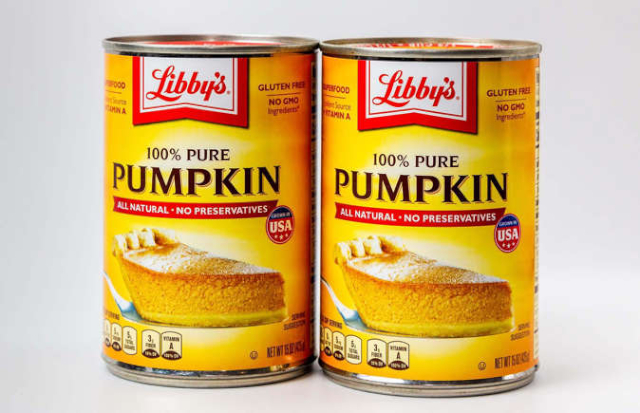
The label says ‘100% Pure Pumpkin’. But there may be NO Pumpkin in the can at all. “Deception!” you scream. “Fraud!” you shout. But it’s perfectly legal, according to the laws that govern food labelling in most jurisdictions…
Most veteran cooks know that what is advertised on food package labels isn’t always what’s inside the package. That’s because the US FDA and the corresponding Canadian government agencies give certain foods special dispensation.
What you don’t know…
… May amaze you! And also push your ‘cynical’ button until it jams.
“Supermarket shelves are packed full of foods and drinks bearing labels with reams of information, lengthy ingredient lists and health-boosting claims,” a revealing story from LoveFood teases. “With so much information (and disinformation) available, it can be confusing to know which products to choose, and which to leave behind. With exactly that in mind, here we reveal the most common food label secrets you need to know about.”
And once you’ve taken in this post, you’ll likely agree with me, that’s an understatement!
What’s going on?
It’s about helping the farmers sell crops, and helping the food packagers fill the demand. And it’s all about where the government regulatory agencies draw the official line at what can and can’t be lab-elled in a certain way.
Did you know…?
‘100%’
The FDA allows products made from ‘golden-fleshed, sweet squash or mixtures of such squash and field pumpkin’ to be sold as pumpkin. Really. And there are many more ‘allowed substitutions’.
‘Organic’
In both the US and UK, food labelled as organic has to contain at least 95 percent organic ingredients; however, something labelled as ‘made with organic ingredients’ can contain up to 30 percent non-organic ingredients.
‘Natural’
We’ve been over this ground a couple of times before. But folks still don’t seem to get the message. Or maybe they just don’t want to know. Anyway…
“According to the US Food and Drug Administration (FDA), when the term ‘natural’ appears on a pro-duct, it doesn’t necessarily mean much. […] Policies regarding the ‘natural’ label do not relate to the use of synthetic pesticides, hormones, antibiotics and genetically modified organisms in livestock and crops.”
‘Fruit Flavoured’
This enticing term doesn’t guarantee there’s any fruit in the product at all. It might contain artificial flavouring (only disclosed in small print),
‘Drink’
When you see this on the label of your breakfast fruit ‘juice’, you’re probably getting something that’s not 100 percent juice, or may not contain any real juice at all.
‘Fat’ and ‘Sugar’
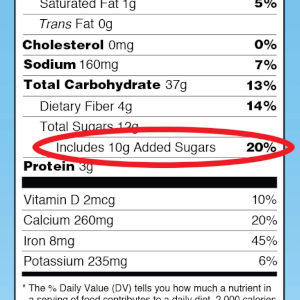
Even on the official nutrition Facts label, fat and sugar content may be stated in a manner that can mislead. You want to key tour decision to buy on ‘Added Sugar’, and ‘Saturated Fat’, which are usually stated as sub-entries in the list.
Just a few…
The forgoing are just a few of the most egregious among the many ‘allowances’ the FDA, as well as UK, Canadian and other Western regulatory authorities allow food processors and packagers to use to conceal the truth about their products.
My take
You have to fend for yourself when interpreting language and even straight-up statistics on food package labels.
I know you’re in a hurry – but take time to READ THE LABEL!
~ Maggie J.