
Diets we occasionally spotlight in this space usually focus on the health of the diner. But the Planetary Health Diet is good for the world, as as well. And a new follow-up study says it’s a win-win solution, offering major health benefits…
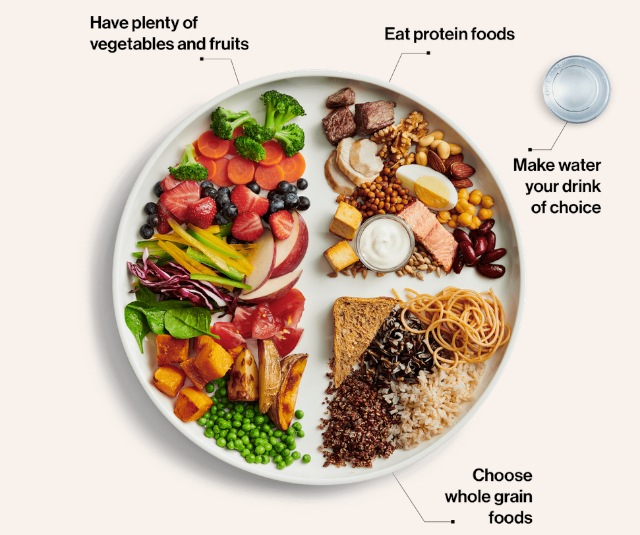 Canada’s Food Guide: The Perfect Plate. Separated at birth from the Planetary Health Diet?
It’s called the Planetary Health Diet (PHD), and it was developed in 2019 as part of the the EAT-Lancet Commission. The idea was to look forward ten or 20 years, taking into account the sustainability of the major food sources we now have available, and suggesting what we all might be eating, or preparing to eat in the future.
Time for a follow-up
“The planetary health diet is a global reference diet for adults that is symbolically represented by half a plate of fruits and vegetables,” the official description begins. “The other half consists of primarily whole grains, plant proteins (beans, lentils, pulses, nuts), unsaturated plant oils, modest amounts of meat and dairy, and some added sugars and starchy vegetables.”
And it’s specifically designed to be adaptable to any dining lifestyle preference
“The diet is quite flexible and allows for adaptation to dietary needs, personal preferences and cultural traditions. Vegetarian and vegan diets are two healthy options within the planetary health diet but are personal choices.”
What more could you want?
Some folks will immediately say, “More meat!” Tough luck. If anything less meat is in the future. And maybe, for many of us, none at all. That’s due primarily to a combination of the waning sustainability of livestock farming, and continuing high prices that are putting animal protein farther and farther out of reach economically for the masses.
If you’re still of the opinion that lentils, beans and peas can never take the place of beef, pork or chicken, I challenge you to review the official PHD Recipes page – and not come away with yiur mouth watering.
What’s sauce for goose…
… (in this case, you and me) is sauce for the gander (Planet Earth). That old maxim is all too appro-priate in this con-text. The PHD advocates a retro approach to nutrition that can be traced back without a break for thousands of years, and is still the norm for an overwhelming number of the world’s diners. Asia, India and Southeast Asia have always followed diets that minimize animal proteins and showcase veggie sources.
And that win-win situation?
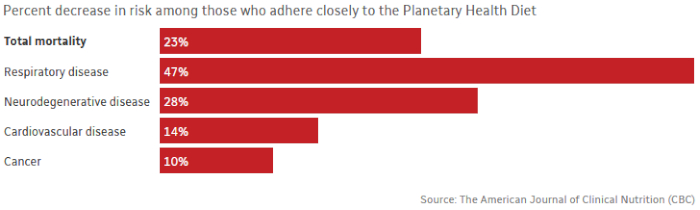
Walter Willett, Professor of Epidemiology and Nutrition at the Harvard T.H. Chan School of Public Health, helped design the PHD. And he says his follow-up study of its effects on diners showed the eating regimen can significantly lower your overall risk of death from all causes.
“It wasn’t just one cause of death. It was right across the board!”
The massive data mining survey analyzed decades of health information from more than 200,000 health care workers. And it came up with conclusive results. The closer subjects’ reported eating habits came to matching the PHD, the greater the benefit. How significant a benefit?
Oh, Canada!
And one angle that makes me beamingly proud to be a Canadian is… The PHD organization cites Canada’s Food Guide (CFG) as the ideal reference for those who want to adopt its diet. A glance at the CFG perfect plate shows it’s half filled with fresh produce…
“Canada’s Food Guide is largely consistent with a sustainable dietary pattern,” says Benoît Lamarche, Scientific Director of Laval University’s NUTRISS centre, and who recently authored a paper compar-ing the Guide to the PHD.
My take
I’m all for the recommendations of the latest (2019) update of Canada’s Food Guide. And the PHD. They’re literally fraternal twins.
But I’m concerned about the availability and cost of the central elements of the PHD/CFG shopping list. Not so much, will there be enough? But can the average person afford it?
~ Maggie J.