
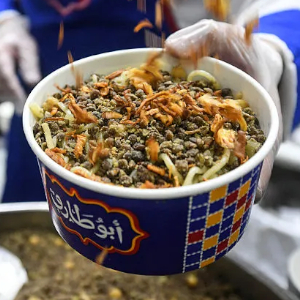
It’s probably Egypt’s most popular street food. But Koshari is little known in the rest of the world. Perhaps this post will help earn this unheralded, anytime ‘treat’ the positive attention it deserves!
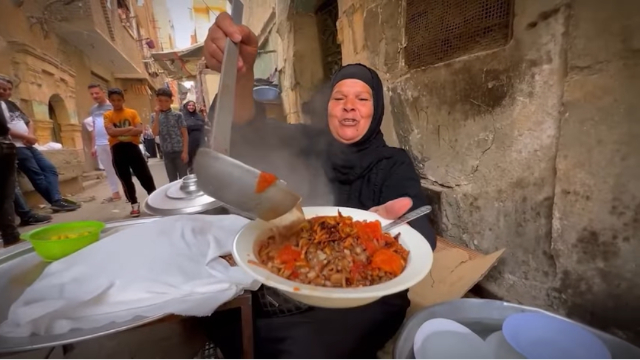
What it is…
“At its heart, Koshari layers everyday ingredients: rice, brown lentils, crispy fried onions, tomato sauce, vermicelli, another pasta, chickpeas, garlicky vinegar dressing and chili oil,” Smithsonian Magazine explains. “For some, the magic lies in combining these components into one dish with strong flavours. For others, the combination remains baffling…)”
And therein may lie the rub. If you can’t figure out what it is, you’re not likely to try it. I admit, I couldn’t tell what-all was in Koshari the first time I looked at a close-up photo.
A love-hate relationship
“I love Koshary,” says 29-year-old Cairo resident Nada Adam. “The secret of its flavour lies in the seas-oning, because without it, Koshari is just a lot of starch and sauce.”
Samar Ashraf, 37, remains unconvinced. “I don’t like the idea of combining carbohydrates—rice, pasta and lentils,” she says. “I also don’t like the sauce, which is full of tomatoes and onions.” She describes the mixture as ‘strange’.
But the lovers definitely outweigh the haters. In fact, Cairo has dozens of Koshari-themed restaurants along with the thousands of street and market stalls.
A ‘loaded’ start
Because Koshari is high in carbohydrates and protein (rice, pasta, lentils, chickpeas), it is considered a very heavy, energetic breakfast. Great for those who work in construction, high-performance ath-letes or others who burn a lot of calories through the day.
But it’s more commonly consumed as an on-the-go lunch or at supper. It’s just a hearty, filling, satis-fying meal-in-a-bowl!
Regional variety
“While UNESCO presents Kosharyi as having a unified national heritage, the dish is prepared in dif-ferent ways across Egypt,” The Smithsonian reports. “Cairo’s version uses rice and brown lentils; In Alexandria, cooks include rice, yellow lentils and boiled eggs; the version in Suez incorporates rice, yellow lentils and shrimp.”
Which means you can put pretty much whatever you want in it when you make it at home!
But to be authentic Koshari, you must observe some traditional standards:
Carbs should be rice and/or lentils. Pasta was only introduced in the 1950s when grains and pulses shot up in price.
You must include onions.
Tomato- and vinegar-based sauces are drizzled on top. But other sauces are already in vogue across the Koshari stalls of Cairo…
And crispy-fried onions must be added generously as a garnish.
My take
Koshari is one of those dishes I love because they’re more a technique than a specific, set recipe. Dare I say, an opportunity to use up some leftovers?
But the real allure of this dish is its richness in plant proteins! If you choose the right grains and pulses, you can concoct a vegetarian dish that provides a ‘complete dietary protein’ as well as a tasty, filling bite!
~ Maggie J.